| Quick answer Nisab is the minimum amount of wealth a Muslim must hold before zakat becomes due. It is fixed in metal, not in dollars: 87.48 grams of gold or 612.36 grams of silver. At August 2026 spot prices that is roughly $12,950 by the gold standard and roughly $1,370 by the silver standard. If your net zakatable wealth is below the standard you follow, you owe no zakat this year. If it is at or above it, and has stayed there for a lunar year, you owe 2.5 percent of the whole amount. Most US scholars and charities recommend the silver standard. |
Nisab is the question that comes before every other zakat nisab question, and it is the one most people skip. They go straight to 2.5 percent without first checking whether they are a zakat payer at all. That matters in both directions. Some people pay zakat they do not owe. Others assume the threshold is high, decide they are under it, and never check. Since zakat is one of the five pillars, getting this line right is not a detail. It decides whether an obligation exists.
Table of Contents
This article covers only the threshold: where it comes from, the two figures, how to convert them into US dollars this year, and what to do at the edges. It does not walk through valuing every asset. For that, use the step by step zakat calculation, which takes the nisab figure from here and applies it in Step 3.
What Nisab Is and Why It Exists
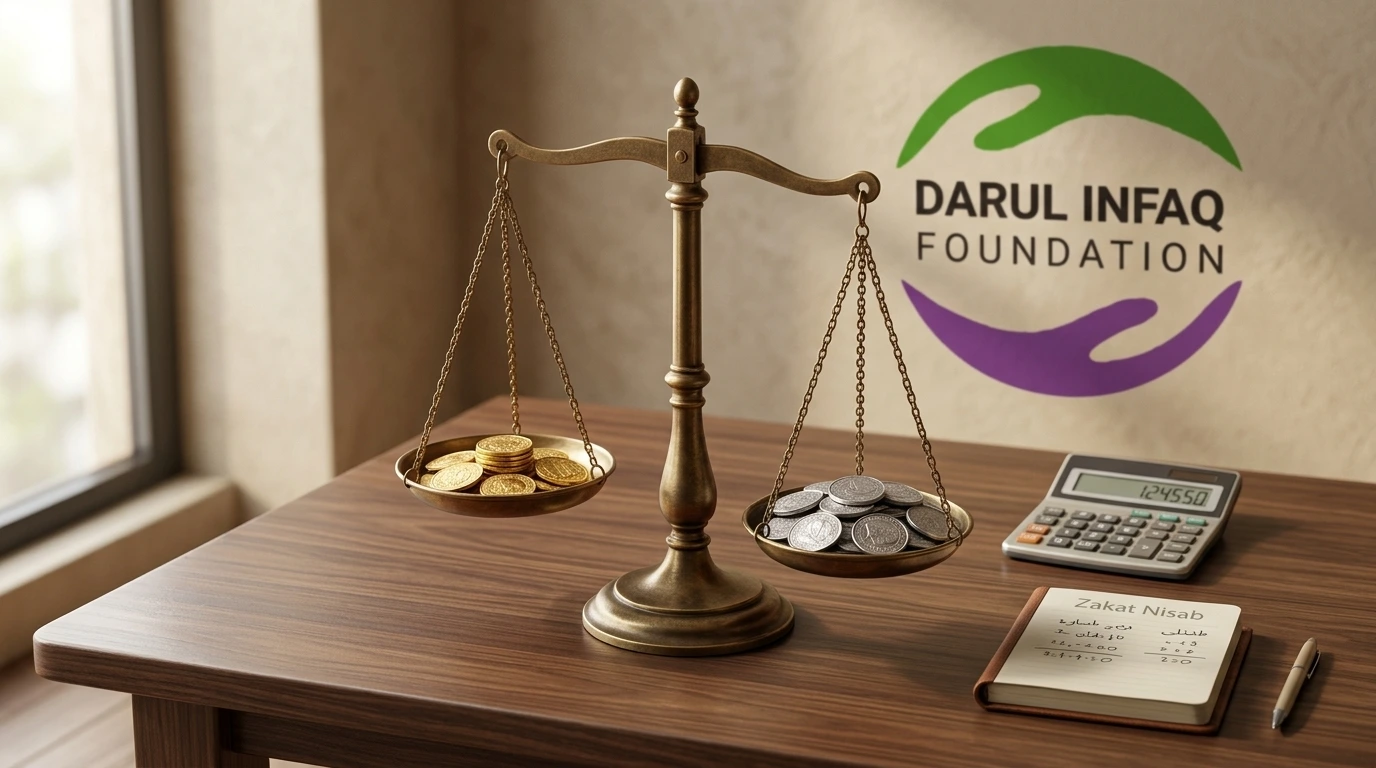
The word nisab means origin or basis, and in zakat law it marks the point at which wealth becomes substantial enough to carry an obligation to others. The Prophet, peace be upon him, set it in specific quantities of the two currencies of his time: 20 dinars of gold and 200 dirhams of silver. Scholars converted those coin counts into weights, and the weights are what we still use today. The purpose is protective. A person with a little money set aside is not asked to give any of it away. Only a person holding a reserve is.
Two things follow from the rule being set in metal rather than currency. First, nisab in dollars changes every day, because gold and silver prices change every day. Second, there is no official nisab published by any government or council. Every figure you see online is somebody’s conversion of the same two weights at a chosen moment, and you can do the conversion yourself in under a minute.
The Gold Standard and the Silver Standard: The Two Figures
| Standard | Classical measure | Weight today | Troy ounces | USD, mid August 2026 |
| Gold | 20 dinars | 87.48 grams | 2.8125 oz | About $12,950 |
| Silver | 200 dirhams | 612.36 grams | 19.6875 oz | About $1,370 |
Based on spot prices of roughly $4,600 per ounce for gold and $69.70 per ounce for silver in the third week of August 2026. Prices move daily. Recheck on your own zakat date.
In the seventh century the two figures were close in value, roughly seven dirhams to a dinar, so it made no practical difference which one you used. That is no longer true. Gold is now worth about 66 times as much as silver per ounce, so the gold nisab sits roughly nine times higher than the silver one. That gap is the whole reason this question exists.
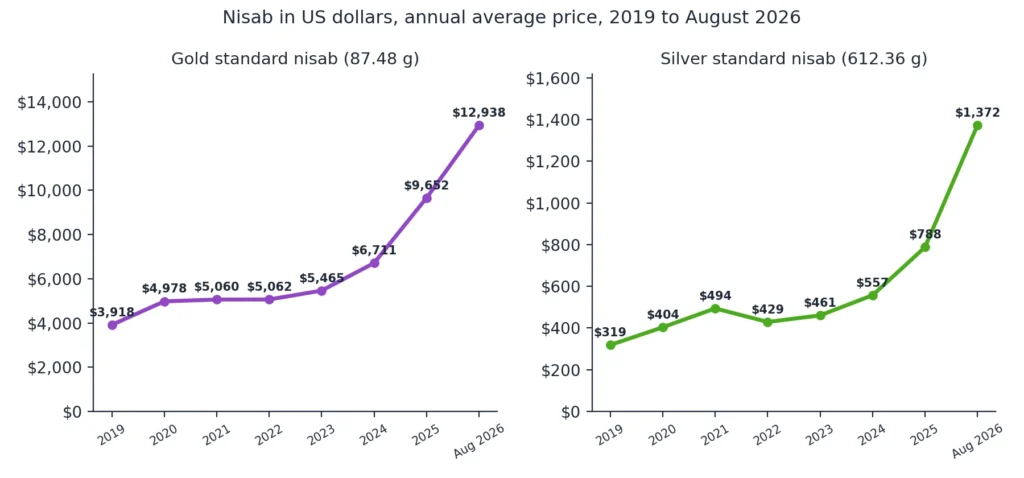
Figure 1. Both thresholds have risen sharply since 2023 as metal prices climbed. Someone who owed zakat on $1,000 of savings in 2023 owes nothing on the same $1,000 in 2026 by the silver standard.
Which Standard Should You Use, and Why Scholars Differ
There is no consensus, and this article will not pretend otherwise. The positions below are all held by qualified scholars.
| Position | Who holds it | Reasoning | Practical effect |
| Silver standard | Majority of contemporary scholars, most US and UK Muslim charities, the Hanafi default | The lower threshold brings more wealth into zakat and so benefits the poor, and when two valid measures exist the one more generous to recipients is preferred. | More people owe zakat. Anyone with roughly $1,400 or more in savings, gold and investments pays. |
| Gold standard | A significant minority, including scholars who argue silver has lost its monetary role | In the Prophet’s time both measures were roughly equal, and gold has kept that value while silver has collapsed relative to it. Gold therefore reflects what nisab originally meant. | Fewer people owe zakat. Only those holding roughly $13,000 or more pay. |
| Lower of the two, whichever it is | Some scholars and several fiqh councils | Since either is valid and zakat is a right of the poor, take the one that triggers the obligation first. | In practice identical to silver for as long as silver remains the lower figure. |
Our own position is the silver standard, for the reasons in the first row, and it is the threshold our Zakat ul Maal appeal assumes. What we ask is not that you agree with us, but that you choose one standard, write down why, and keep to it. Switching to gold in a year when it would exempt you and back to silver in a year when it would not is not a legal opinion. It is avoidance.
Converting Nisab Into US Dollars This Year
You do not need a calculator page. You need the spot price and one multiplication. Here is the conversion in full, using the silver standard and the gold standard side by side.
| Step | Silver standard | Gold standard |
| 1. Find today’s spot price per troy ounce | $69.70 per oz (example) | $4,600 per oz (example) |
| 2. Convert to a price per gram: divide by 31.1035 | $2.24 per gram | $147.89 per gram |
| 3. Multiply by the nisab weight | 612.36 g × $2.24 | 87.48 g × $147.89 |
| 4. Nisab in USD | About $1,372 | About $12,937 |
Three honest cautions about the number you get. Use the spot price, not the retail price of coins or jewellery, which includes a dealer premium. Use the price on your zakat date, not a yearly average and not the highest or lowest point you can find. And do not compare nisab against your gross assets; compare it against your net zakatable wealth after deductible debts, which is a smaller figure for most households.
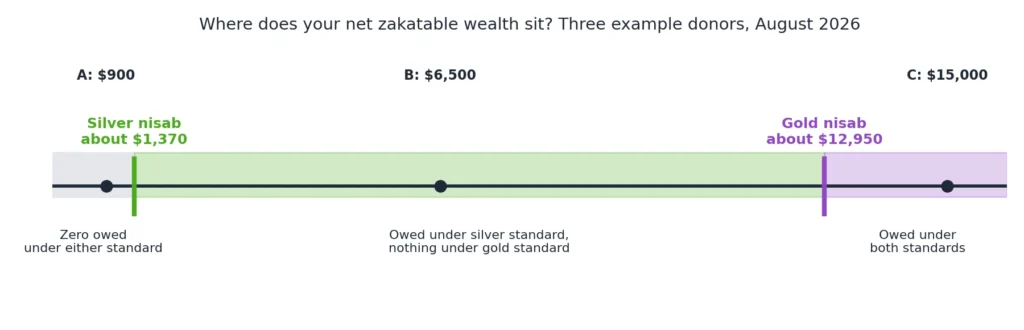
Figure 2. Donor A owes nothing. Donor B owes $162.50 by the silver standard and nothing by the gold standard. Donor C owes $375 under either.
What To Do When Your Wealth Crosses Nisab Mid Year
Nisab is not checked once a year in isolation. It interacts with the hawl, the lunar year your wealth must be held. The scenarios below cover the situations donors actually ask about.
| Situation | What happens |
| You crossed nisab for the first time on 3 March | 3 March becomes your zakat anniversary. Zakat is due one lunar year later, around 20 February, on whatever you hold that day. Write the date down. |
| You were above nisab, dipped below it in month seven, and recovered by the anniversary | Hanafi view: only the start and end of the year matter, so zakat is due. Majority view: the hawl broke when you dipped, and a new year starts from the day you recovered. |
| You were above nisab, dropped below it, and are still below on the anniversary | No zakat is due for that year under any school. |
| You received a large sum two weeks before your anniversary | Hanafi view: it merges with the existing wealth and is zakatable on the anniversary. Majority view: new money of the same type starts its own hawl, though many scholars advise paying on it anyway for simplicity. |
| Metal prices rose and pushed nisab above what you hold | You are below nisab this year and owe nothing. This happened to many small savers between 2024 and 2026. |
If You Are Below Nisab: What You Can Give Instead
Being below nisab means you have no zakat obligation. It does not mean you are shut out of giving. Sadaqah has no threshold, no fixed rate and no fixed date, and its reward is measured against what you had rather than what you gave. If you want the distinction spelled out, read how zakat and sadaqah differ before you give, because the two are recorded and distributed differently and should be intended differently.
| Option | Threshold | Notes |
| Sadaqah of any amount | None | Give what you can, when you can, with the intention of sadaqah rather than zakat. |
| Zakat al Fitr before Eid | Food beyond your needs for that day | Still owed by nearly everyone, including people below nisab. It is a separate obligation with a fixed per person amount. |
| Non financial charity | None | Time, skills, a kind word, removing harm from a path. All named as charity in the hadith. |
| Receiving rather than giving | Below nisab, in some views | If you are below nisab and struggling, you may be eligible to receive zakat yourself. Several scholars use nisab as the line for eligibility. |
That last row is said plainly because it is often left out. Zakat exists for people in exactly that position, and there is no shame in it. If you are the one under pressure this year, our financial assistance programme accepts applications, and you can give sadaqah online if you would still rather give a small amount than receive.
Above Nisab This Year?
Then zakat is due, and where it goes matters as much as whether you paid it. Zakat we receive is kept separate from general donations and distributed only to households verified against the eight categories. You can read how we report where funds go in our published financial reports, and give your zakat through the donation form once your figure is settled.
Frequently Asked Questions
What is the zakat nisab in 2026?
87.48 grams of gold or 612.36 grams of silver. At August 2026 spot prices that is about $12,950 by gold and about $1,370 by silver. The weights never change; the dollar figures move with the metal price.
What is the nisab threshold in US dollars right now?
Multiply today’s spot price per gram by 612.36 for silver or 87.48 for gold. Using the third week of August 2026 as an example: about $1,372 and about $12,937. Check the price on your own zakat date.
Should I use the gold or silver nisab value?
Most contemporary scholars and US charities advise silver, because the lower threshold benefits recipients. Some hold that gold reflects the original intent. Choose one, record your reason, and apply it consistently.
Why is nisab fixed at 87.48 grams of gold and 612.36 grams of silver?
Those are the modern weights of 20 gold dinars and 200 silver dirhams, the amounts set in the hadith. The rule is set in metal so that it keeps its value across centuries and currencies.
Do I compare nisab to my savings or to my total net worth?
To your net zakatable wealth: cash, savings, gold, silver and investments held on your zakat date, minus debts due now. Not to your home, car or the full balance of long term loans.
| A note on the dollar figures in this article Every dollar amount here is an illustration based on prices in August 2026. Gold and silver both moved more than 40 percent in the last year alone. The only figures that are permanently true are 87.48 grams and 612.36 grams. Convert them yourself on the day your zakat falls due. |