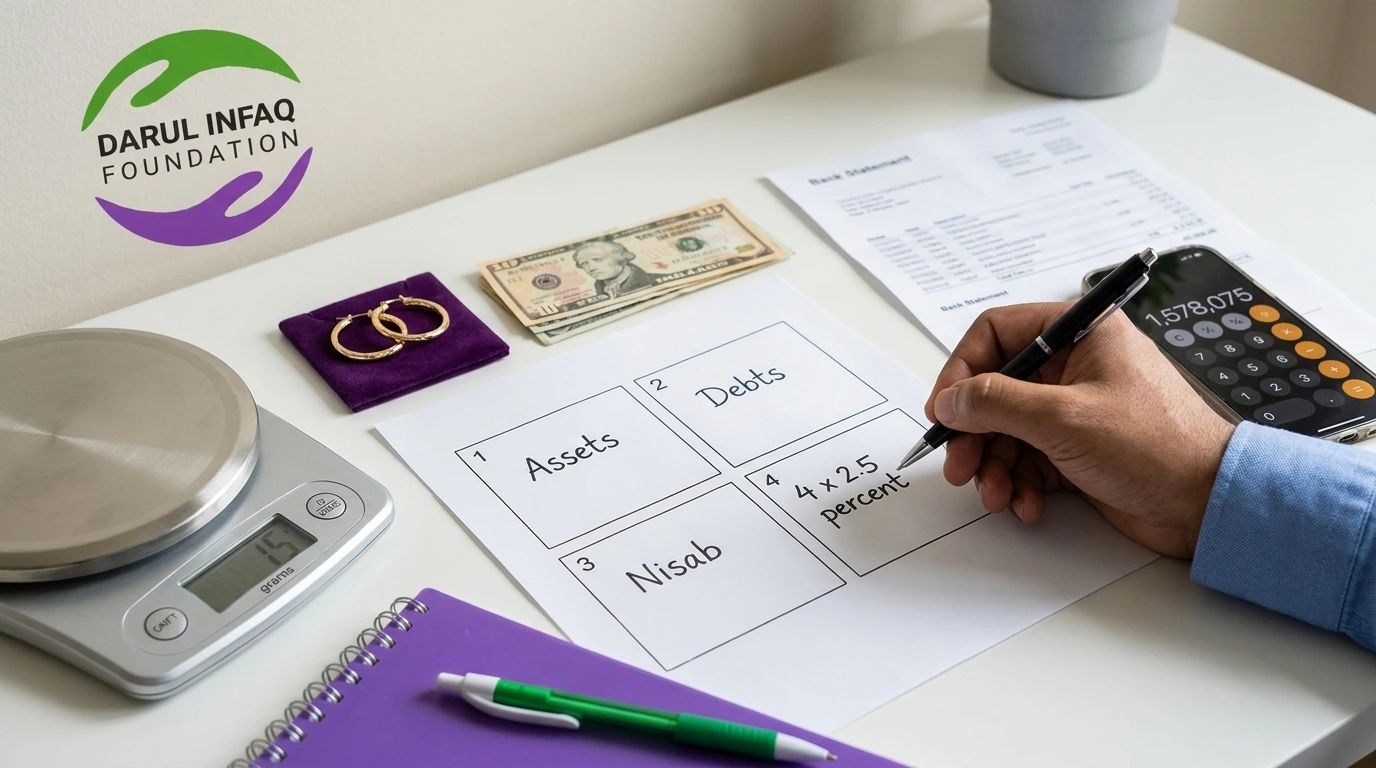
| Quick answer To calculate zakat, add up every zakatable asset you own on your zakat date (cash, bank savings, gold, silver, shares, business stock and money that is owed to you), subtract only the debts that are due right now, and compare what is left with nisab. In mid August 2026 nisab is roughly $1,370 by the silver standard or roughly $13,000 by the gold standard. If your net figure is above the standard you use, you owe 2.5 percent of it. Zakat is calculated on wealth you have held for one lunar year, not on your salary. |
Most people who search for how to calculate zakat already know the number 2.5 percent. What they do not know is 2.5 percent of what, on which date, and after subtracting which debts. Those three gaps are where nearly every zakat calculation goes wrong, and they are the reason two families with the same income can arrive at figures hundreds of dollars apart. If you are still unclear on what zakat is and why it is obligatory, read that first, because this guide assumes you already accept the obligation and simply want to work out the amount correctly.
One point before the method. Zakat is a fixed, calculated duty with a threshold, a rate and a due date. It is not a loose percentage of what you feel able to give, and zakat and sadaqah are not the same thing. Sadaqah given during the year does not reduce the zakat you owe unless you specifically intended it as zakat at the time you gave it. That distinction matters more than most calculators admit.
Before You Calculate: The Three Things Zakat Depends On
Every zakat calculation method, whether it is a printed worksheet from your mosque or an online calculator, rests on three terms. If you understand these three, you can check any calculator rather than trusting it blindly.
| Term | What it means | Why it changes your number |
| Nisab | The minimum amount of wealth a person must hold before zakat becomes due. It is set in weights of gold (87.48 grams) or silver (612.36 grams) and converted to dollars at today’s price. | If your net zakatable wealth is below nisab you owe nothing at all. Above it, zakat applies to the whole amount, not just the part over the line. |
| Hawl | One full lunar year (about 354 days). Wealth must have been at or above nisab for a complete lunar year before zakat is due on it. | Your zakat date is personal. It is the anniversary of the day your wealth first crossed nisab, not Ramadan and not 31 December. |
| Zakatable assets | The categories of wealth zakat applies to: money, gold and silver, trade goods, receivables and, by extension, most modern investments. | Your house, car, furniture and tools of your trade are not zakatable. Including them is the most common cause of overpaying. |
Notice what is missing from that table: your income. Zakat is not 2.5 percent of your salary. It is 2.5 percent of the wealth that survives the year. A person earning $150,000 who spends all of it owes nothing. A person earning $45,000 who has quietly saved $20,000 owes $500. That is not a loophole. It is the design.
Step 1: List Every Zakatable Asset You Hold
Take the balance of each item on your zakat date, not the average over the year and not the balance you wish you had. Use actual statements. The table below shows what counts and how to value it. Where scholars differ, both positions are given, because pretending there is a single answer is how people end up paying the wrong amount with confidence.
| Asset | Zakatable? | How to value it on your zakat date |
| Cash at home, checking and savings accounts | Yes | Statement balance on the date. Include foreign currency at the exchange rate that day and digital wallet balances such as PayPal or Venmo. |
| Money set aside for a house deposit, wedding or car | Yes | Full amount. Earmarking money for a purpose does not remove it from your ownership. |
| Gold and silver, including jewellery | Yes (Hanafi). Worn jewellery in regular use is exempt in the Shafi, Maliki and Hanbali schools | Weight in grams multiplied by purity multiplied by spot price. 22 karat is 91.7 percent pure, 18 karat is 75 percent. |
| Shares and funds bought to trade | Yes | Full market value on the date. |
| Shares and index funds held long term | Yes, partially or fully | Either full market value (simplest and safest), or the zakatable portion of the underlying companies, commonly estimated at 25 to 30 percent of value. |
| 401(k), 403(b), IRA | Yes on the vested balance, with two approaches | Approach A: net accessible value after early withdrawal penalty and estimated tax. Approach B: full vested balance. Unvested employer contributions are not yours yet and are excluded under both. |
| Money owed to you that you expect to receive | Yes | Face value, if the borrower is willing and able to repay. Doubtful debts are counted only when actually recovered. |
| Business inventory and receivables | Yes | Stock at current selling value plus invoices you expect to be paid. Equipment, vehicles and premises are excluded. |
| Rental property | The building no, the rent yes | Only the rental income still in your possession on the date. |
| Your home, car, furniture, clothing, tools | No | Personal use assets are not zakatable regardless of value. |
| Interest earned in a bank account | No, and it is not yours | Do not include it in zakat and do not keep it. Give it away without the intention of reward. |
The retirement account line deserves a plain word. Approach A produces a smaller zakat figure and is the position of several major North American fiqh bodies on the grounds that you cannot actually access the full balance. Approach B is the stricter reading and is favoured by scholars who argue that ownership, not access, is what matters. Pick one, write down why, and apply it consistently every year. Switching approaches depending on which gives the lower number is not a fiqh position.
Step 2: Subtract the Debts That Are Actually Deductible
This is the step where people most often underpay, usually by subtracting the entire balance of a mortgage or student loan. The rule across the schools is narrower than that. You may deduct debts that are due and payable now, or within the coming year at most, because those genuinely reduce the wealth you have at your disposal. A 30 year mortgage does not reduce your wealth by its full balance this year. It reduces it by the instalments due.
| Debt | Deductible? | Notes |
| Credit card statement balance | Yes | The amount currently owed, not your credit limit. |
| Utility bills, rent or taxes already due | Yes | Anything overdue or due this month. |
| Mortgage | Only the instalments due now, or the next twelve months at most | Deducting the full principal is the single largest cause of underpayment among US Muslims. |
| Student loans | Only instalments currently due. Many scholars advise against deducting loans in deferment at all | Long term deferred debt does not reduce today’s disposable wealth. |
| Car finance | Instalments due now | Same principle as a mortgage. |
| Money you borrowed from a relative with no fixed repayment date | Deduct only if you actually intend to repay it this year | Be honest with yourself here. A loan you have no plan to repay is not a deduction. |
| Zakat you owe from previous years | Yes | Unpaid zakat is itself a debt owed to its recipients. |
There is a second side to debt that is worth knowing. A person crushed by debt they cannot service is one of the eight categories the Quran names as eligible to receive zakat. If your honest calculation shows that your debts due now exceed your assets, you are not a zakat payer this year, and depending on your circumstances you may be someone zakat is meant for. There is no shame in that. Our financial assistance programme exists for exactly that position.
Step 3: Check Your Total Against Nisab
Take your zakatable assets, subtract your deductible debts, and you have your net zakatable wealth. Now compare it with nisab. There are two standards and they produce very different dollar figures, so this is a decision you have to make consciously rather than let a calculator make for you.
| Standard | Weight | Approximate spot price, mid August 2026 | Nisab in USD (approx.) |
| Silver | 612.36 grams | About $2.24 per gram | About $1,370 |
| Gold | 87.48 grams | About $148 per gram | About $12,950 |
Spot prices move daily. These figures are for illustration only. Check the live price on your own zakat date and use that.
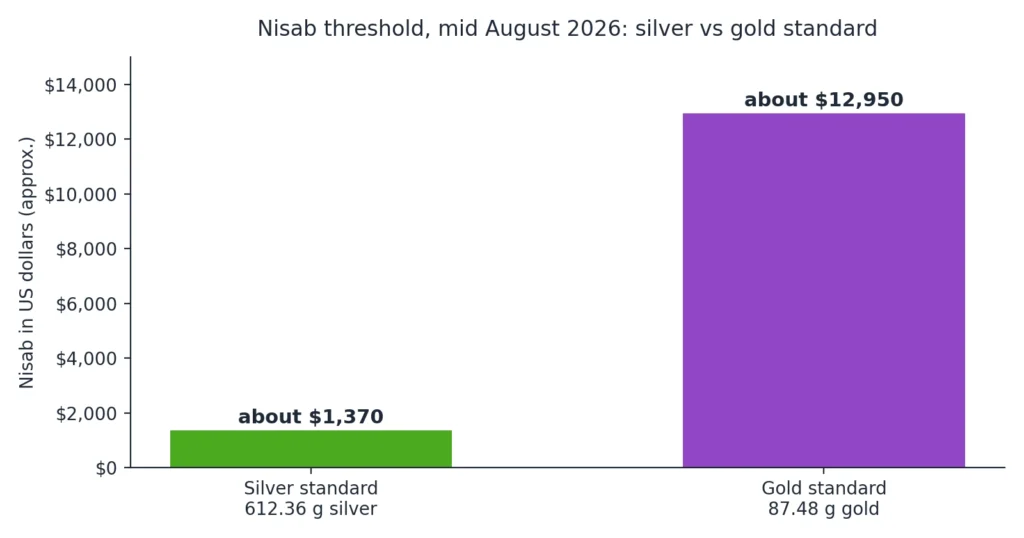
Figure 1. The silver standard sets the threshold roughly nine times lower than the gold standard at current prices.
Which one should you use? The majority of contemporary scholars and nearly every Muslim charity in the United States recommend the silver standard, on the principle that the lower threshold benefits the poor and errs on the side of paying. Some scholars argue that the gold standard better reflects what nisab meant historically, when the two metals had a fixed ratio to each other. Both positions are held by serious people. What is not defensible is choosing gold in a year when it lets you avoid paying and silver in a year when it does not.
A practical point. If your net wealth sits above the silver nisab but below the gold nisab, say $8,000, you owe $200 by the silver standard and nothing by the gold standard. Decide your standard once, record it, and keep it.
Step 4: Apply 2.5 Percent (and Why It Is 2.5 Percent of Wealth, Not Income)
If your net zakatable wealth is at or above the nisab you have chosen, and it has stayed at or above nisab through the lunar year, multiply it by 0.025. That is the whole formula.
| The formula Zakat owed = (zakatable assets on your zakat date minus debts due now) × 0.025 Only if the result of the bracket is at or above nisab. If it is below, zakat owed is zero. |
The 2.5 percent rate comes from the hadith literature, where it is expressed as a quarter of a tenth (rub’ al ushr). It applies to money, gold, silver and trade goods. Different rates apply to agricultural produce (5 or 10 percent), livestock (by head count) and buried treasure (20 percent), but for a salaried household in the United States the rate you need is 2.5 percent.
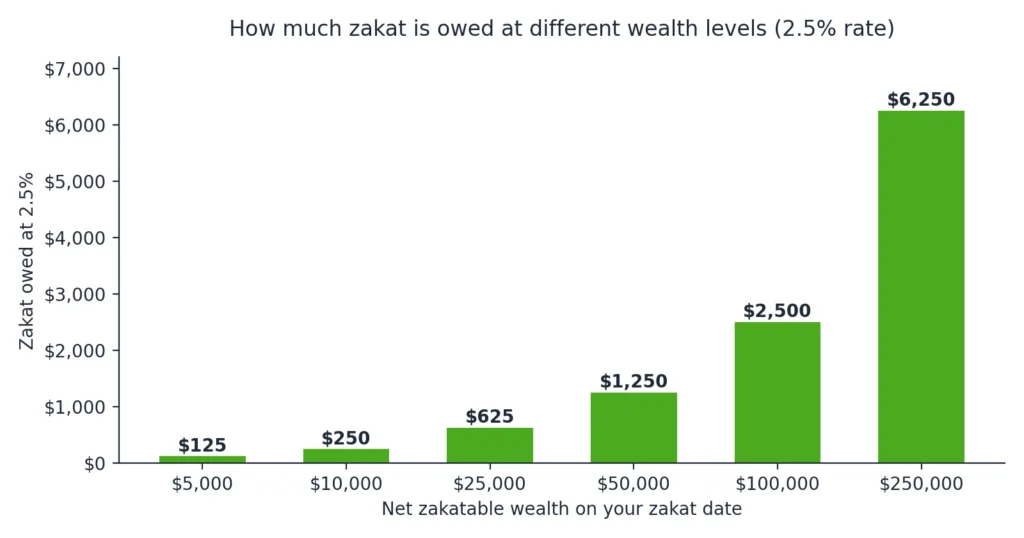
Figure 2. Zakat scales in a straight line with net wealth. There are no bands and no allowances above nisab.
Two things people get wrong at this step. First, the rate applies to the whole net amount, not to the portion above nisab. If nisab is $1,370 and you hold $10,000, you owe $250, not $216. Second, zakat is not a tax deduction from your salary. If your wealth dipped below nisab during the year and came back up, in the Hanafi school only the start and end of the year matter, whereas the majority position restarts the hawl from the day you crossed nisab again. Once you have your figure, you can give your Zakat ul Maal in a single payment, and we distribute it only to recipients who fall inside the eight Quranic categories.
A Full Worked Example: A US Household With Savings, Gold and a 401(k)

Here is a two income household in Texas. They follow the Hanafi school, so worn jewellery counts, and they have chosen the silver nisab and the accessible value approach for the 401(k). Their zakat date is 12 August, the anniversary of the day their savings first passed nisab six years ago. Every figure is taken from a statement dated that day.
| Item | Detail | Amount |
| Checking account | Joint account, balance on 12 August | $6,200 |
| Savings account | Emergency fund plus money set aside for a car | $18,500 |
| Gold jewellery | 120 grams of 22 karat, so 110 grams of pure gold at $148 | $16,280 |
| 401(k), vested | $64,000 vested balance. Accessible value after 10 percent penalty and 22 percent estimated tax is 68 percent | $43,520 |
| Brokerage account | Index funds held long term, valued at full market value for simplicity | $12,000 |
| Loan to a cousin | Expected back within the year | $2,000 |
| Total zakatable assets | $98,500 | |
| Credit card | Statement balance due | minus $1,900 |
| Mortgage | Next instalment due, not the $310,000 balance | minus $2,300 |
| Car loan | Next instalment due | minus $450 |
| Net zakatable wealth | Above the silver nisab of about $1,370, so zakat is due on the full amount | $93,850 |
| Zakat owed at 2.5 percent | $93,850 × 0.025 | $2,346.25 |
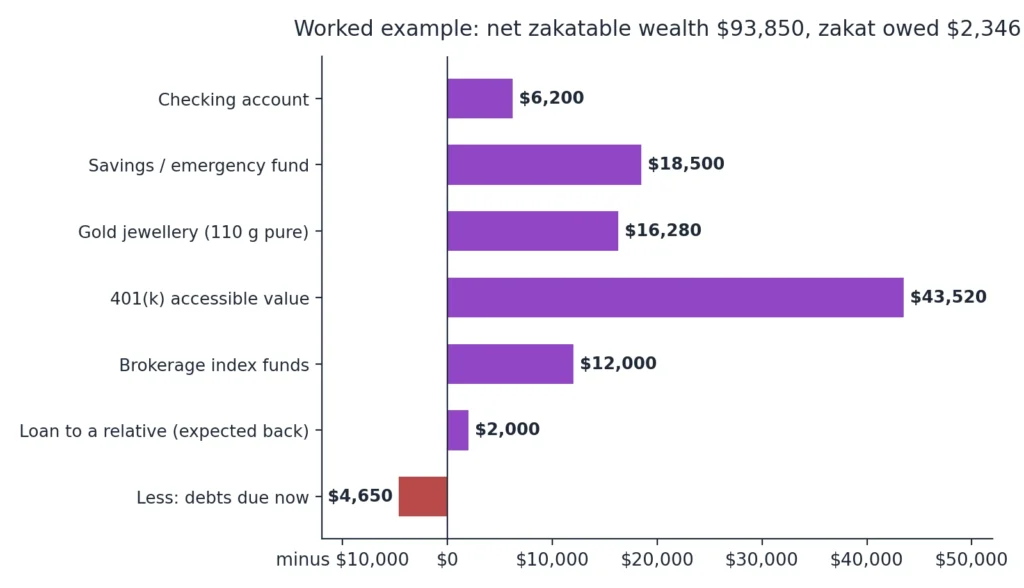
Figure 3. The household’s asset breakdown. The 401(k), even at accessible value, is the largest single line.
Now the honest footnote. Had this family used the full value approach for the 401(k), their assets would have been $119,980, net wealth $115,330, and zakat $2,883.25. That is a $537 difference on one decision. Had they followed the Shafi school and excluded worn jewellery, the figure would have dropped by $407. Neither version is a trick. They are legitimate positions with real consequences, which is why you should know which one you are following and why.
For context on what that figure does: $2,346 funds roughly a full year of monthly groceries for a household through our programme, with money left over.
Five Mistakes That Make People Overpay or Underpay
These are the errors we see most often when donors send us their working. Two lead to overpaying, three lead to underpaying, and all five are avoidable.
| Mistake | Effect | The fix |
| Calculating 2.5 percent of annual income | Usually a large overpayment for savers, and an underpayment for people who earn a lot and save little | Use wealth held on your zakat date, not earnings. |
| Deducting the full mortgage or student loan balance | Underpayment, often to zero | Deduct only instalments due now or within the coming year. |
| Skipping gold jewellery because it is worn | Depends on your school. Hanafi followers underpay | Weigh it, grade it, value it. If you follow a school that exempts worn jewellery, apply that consistently. |
| Ignoring the 401(k) because it is untouchable | Underpayment, frequently by hundreds of dollars | Include the vested balance under one of the two approaches above. |
| Treating Ramadan sadaqah or Zakat al Fitr as part of Zakat al Maal | Underpayment | Only money given with the intention of zakat counts. Zakat al Fitr is a separate obligation, paid per person before Eid prayer, and does not reduce your wealth zakat. |
On that last point, if you are paying both in the same season, keep them separate in your records. Our Zakat al Fitr and fidya page handles the per person payment, and your wealth zakat goes through Zakat ul Maal. Merging them on one receipt is how people convince themselves they have paid more than they have.
What To Do If You Missed Zakat in Previous Years
Unpaid zakat does not expire. It remains a debt owed to its rightful recipients, and the scholarly consensus is that it must be paid regardless of how many years have passed, even if you were unaware of the obligation at the time. That sounds harsh. It is also the position of every major school, so there is no point softening it.
The practical method is estimation. For each missed year, reconstruct your zakatable wealth as best you can using old bank statements, tax returns and your memory of what gold you held. Apply the nisab and 2.5 percent for that year. Where records are gone, make a sincere and reasonable estimate and err slightly on the high side. Then either pay the total at once or set up a schedule that clears it within a defined period. If the total is beyond what you can pay immediately, paying in instalments while sincerely intending to complete it is accepted. Ignoring it is not.
Write the years and amounts down. Give with the explicit intention that this payment is zakat for a specified year. A vague intention that it is charity in general does not discharge a specific missed obligation.
Where Your Zakat Goes When You Give Through Darul Infaq
Zakat is restricted money. It can only go to the eight categories in Surah At Tawbah 9:60, and a charity that mixes it with general funds or spends it on overheads that do not qualify has misused it. Our Zakat ul Maal fund is ring fenced for that reason and is distributed as direct cash grants, food and essential support to households verified against those categories. You can check the allocation yourself in our published financial reports rather than taking our word for it.
Once you have your figure from the steps above, you can donate now and mark the payment as zakat. We are a registered US 501(c)(3), so you will receive a receipt, though your own tax position is something to confirm with your advisor.
Frequently Asked Questions
How is zakat calculated?
Add up your zakatable assets on your zakat date, subtract debts due now, and if the result is at or above nisab, multiply it by 0.025. That gives you 2.5 percent of your net zakatable wealth.
What is the zakat calculation method for gold jewellery?
Weigh the gold in grams, multiply by its purity (22 karat is 0.917), multiply by the spot price per gram on your zakat date, and add the result to your other assets. In the Hanafi school worn jewellery counts. The other three schools exempt jewellery in regular use.
Is zakat 2.5 percent of income or of savings?
Of savings and other wealth held for a lunar year, not of income. Your salary only matters to the extent that some of it is still in your possession on your zakat date.
What are nisab and hawl, and why do they matter?
Nisab is the minimum wealth (87.48 grams of gold or 612.36 grams of silver, in dollar terms) below which no zakat is owed. Hawl is one full lunar year, about 354 days, that the wealth must be held above nisab. Both must be met before zakat is due.
Do I have to pay zakat on my 401(k)?
On the vested balance, yes, according to most contemporary scholars. Use either the accessible value after penalty and tax, or the full vested balance, and apply the same approach every year. Unvested employer contributions are excluded.
| A note on accuracy Where the schools of law differ, this guide states the difference rather than choosing for you. If you have a complex situation, such as a business partnership, property held for resale or debts owed to you that are unlikely to be repaid, ask a qualified scholar. The formula is simple. Your circumstances may not be. |