Quick Answer
Absolute poverty is defined as a severe deprivation of basic human needs, including food, safe drinking water, sanitation facilities, health, shelter, and education. Unlike relative poverty, which shifts depending on a country’s average income, absolute poverty is measured against a fixed global threshold currently set by the World Bank at $3.00 per person per day.
Absolute poverty means lacking the income needed to meet basic physical needs, measured against a fixed threshold that stays the same across every country. The World Bank sets that threshold at $3.00 per person per day, and around 831 million people worldwide live below it. For a wider understanding of economic hardship, you can also review our detailed guide on what causes poverty
Table of Contents
The Measure Rests on Three Features:
- A fixed threshold, not one tied to average incomes.
- The same line applied in every country.
- Measured by consumption or income, not by living standards relative to neighbors.
For a broader academic overview of how deprivation is studied globally, you can also explore the comprehensive entry on Poverty on Wikipedia.
The International Poverty Line
The World Bank sets the International Poverty Line to allow poverty comparisons across countries. Living below it is described as extreme poverty.
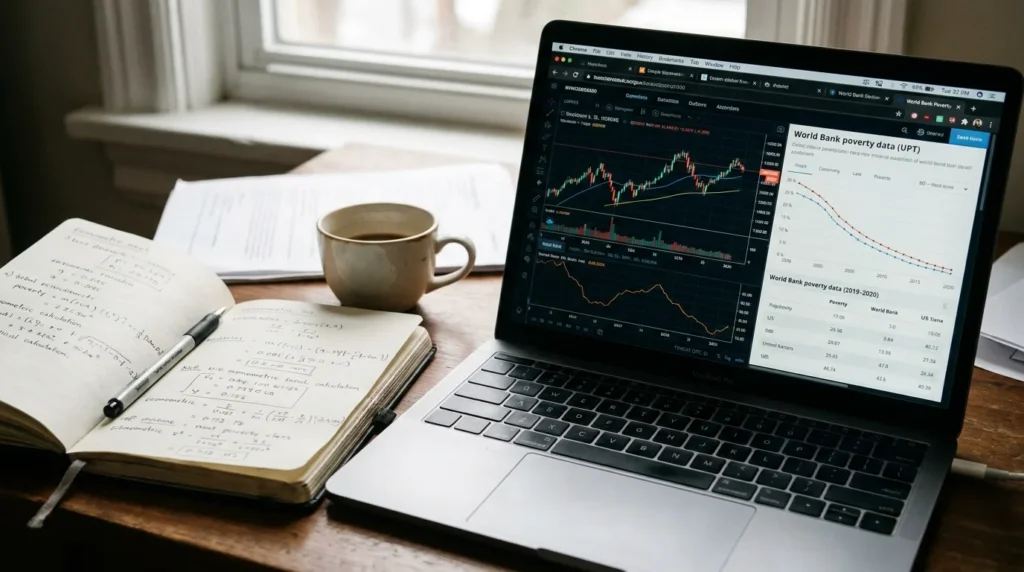
The line stood at $2.15 a day in 2017 prices until June 2025, when the World Bank raised it to $3.00 a day in 2021 prices. The United Nations uses this figure to track progress toward Sustainable Development Goal 1.
Three separate lines apply at different national income levels:
- $3.00 a day for low-income countries.
- $4.20 a day for lower-middle-income countries.
- $8.30 a day for upper-middle-income countries.
The World Bank also publishes a Prosperity Gap, measuring the average shortfall from a standard of $28 a day.
Why the Number Jumped in 2025
The revision reclassified 125 million people as extremely poor overnight, which caused confusion about whether global poverty had suddenly worsened.
It had not. The higher count reflects a higher threshold, not a poorer world. Incomes among the world’s poorest are in fact higher than previously estimated, and the revision corrected a line that no longer matched current prices.
The direction of travel is unchanged under either standard:
- Under the old $2.15 line, around 1.3 billion people left extreme poverty between 1990 and 2022.
- Under the revised $3.00 line, that figure rises to 1.5 billion.
Progress has since stalled. Incomes are stagnant in the places where most of the world’s poorest live, and the World Bank projected 808 million people, or 9.9% of the world’s population, would remain in extreme poverty in 2025. To explore actionable steps toward financial stability, read our guide on how to get out of poverty
Absolute vs. Relative Poverty
The two measures answer different questions, and conflating them produces meaningless comparisons.
- Absolute poverty uses a fixed survival threshold applied identically everywhere. It asks whether someone can meet basic needs.
- Relative poverty uses a moving threshold tied to national median income, commonly set at 60% of the median across the EU and UK. It asks whether someone can participate normally in their own society.
A household can sit above the absolute line and below the relative one. Most households counted as poor in high-income countries fall into exactly that position. For a deeper look into moving benchmarks and societal standards, read our detailed guide on What Is Relative Poverty? Definition, Examples and How It’s Measured.
Absolute poverty can in principle be eliminated. Relative poverty cannot, since it describes a position within a distribution rather than a fixed standard.
What Purchasing Power Parity Means
The $3.00 figure is not converted at market exchange rates, which would make the comparison worthless.
Purchasing power parity adjusts for what money actually buys locally. A dollar converted at the exchange rate buys far more food and housing in Malawi than in Norway, so PPP conversion asks what quantity of goods $3.00 would purchase in the United States and prices the local equivalent.
The current lines use 2021 prices. This is why the threshold is revised periodically rather than left fixed in nominal terms.
Beyond Income
Income alone misses deprivations that define poverty in practice, which is why non-monetary measures run alongside the International Poverty Line.
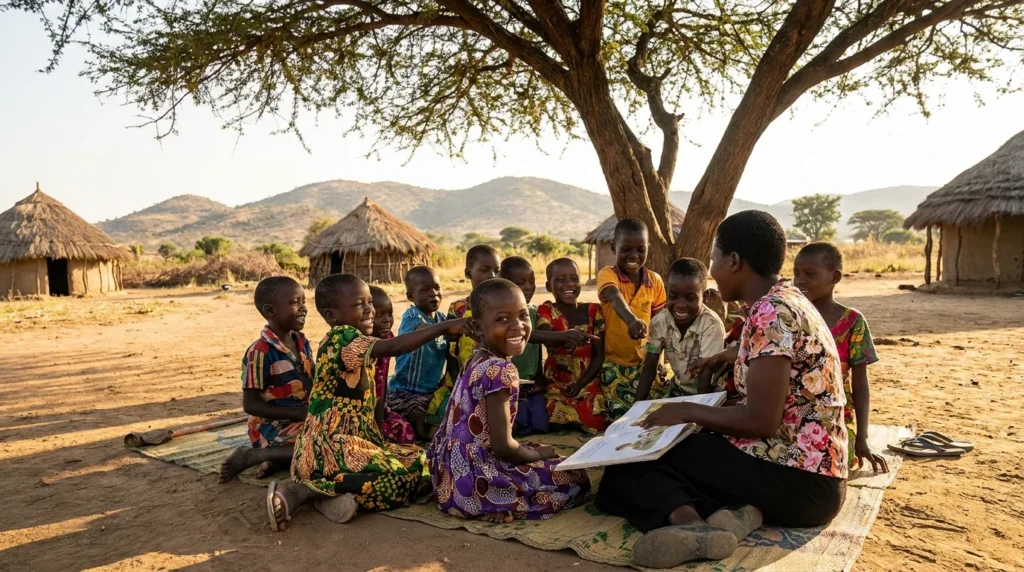
The Multidimensional Poverty Index assesses deprivation across health, education, and living standards, counting indicators such as nutrition, school attendance, sanitation, drinking water, electricity, and housing. For instance, educational barriers are closely examined in our article on how does poverty affect education.
A household can clear the income line while lacking clean water, electricity, and access to a school. Measuring only consumption would record that household as non-poor. These barriers directly impact long-term outcomes, particularly for youth; to see how financial strain cascades through generations, review our breakdown on How Does Poverty Affect Children? What the Evidence Shows.
Where It Is Concentrated
Extreme poverty is no longer globally distributed. It has concentrated sharply in specific regions and country types.
- Sub-Saharan Africa holds the largest share, and fragile or conflict-affected states account for a disproportionate number of the world’s extremely poor.
- The Democratic Republic of the Congo has the largest absolute number of any single country.
- Children carry the heaviest burden. The World Bank estimated 412 million children aged 17 or younger lived in households below $3 a day in 2024, which is roughly one child in five worldwide.
Criticisms of the Measure
The International Poverty Line attracts sustained criticism, and the objections are methodological rather than political:
- The threshold is a judgment call: No objective calculation produces $3.00 rather than $2.50 or $4.00, and small changes move hundreds of millions of people across the line.
- It records position, not depth: Someone at $2.99 a day and someone at $0.50 a day are counted identically.
- PPP conversion is imprecise: Price baskets used for conversion reflect average national consumption, which differs from what the poorest actually buy.
- Survey data is uneven: Some countries survey infrequently, so figures are extrapolated using growth estimates rather than measured.
- Non-market goods go uncounted: Subsistence farming, collected firewood, and unpaid care work are difficult to value in consumption data.
These limitations do not make the measure useless. They mean it should be read alongside multidimensional measures rather than treated as a complete account. To learn more about broader policy strategies, see our article on how to solve poverty.
Calculated your zakat on gold? Pay it where it reaches those who qualify.
Give Your Zakat Now →Frequently Asked Questions
Can absolute poverty be eliminated?
In principle yes, since the threshold is fixed. Sustainable Development Goal 1 targets ending extreme poverty by 2030, though current projections indicate that target will be missed.
Does absolute poverty exist in developed countries?
Rarely by the $3.00 measure, since social protection systems hold incomes above it. Wealthy countries measure relative poverty and material deprivation instead.
Who sets the international poverty line?
The World Bank sets and revises it, most recently in June 2025. The United Nations uses the resulting estimates to track Sustainable Development Goal progress.
What is the difference between poverty and extreme poverty?
Extreme poverty specifically means living below the International Poverty Line. Poverty more broadly can refer to any of the higher income thresholds or to relative measures.
How is absolute poverty measured in practice?
Household surveys record income or consumption, which is converted to 2021 purchasing power parity dollars and compared against the threshold for that country’s income group.