
Quick Answer
To calculate zakat on cash, add up all the money you own on your zakat date (cash at home, checking and savings balances, foreign currency, digital wallets and money owed to you that you expect back), subtract only the debts due now, and compare the result with the nisab: 612.36 grams of silver, about $1,260 at September 2026 prices, or 87.48 grams of gold, about $12,200. If your net cash is at or above the nisab you follow and was above it a lunar year ago, you owe 2.5% of the total. Zakat is paid on the balance you hold on your zakat date, not on your income for the year.
Zakat on cash confuses a lot of people. Money sits in different accounts, some of it arrived last month, some of it is already promised to a bill, and it is not obvious which dollars count. This guide shows you exactly how to add up your money, check the nisab with current prices, handle debts and new income, and work out your payment without second-guessing yourself.
If you have never calculated zakat before, our broader guide on how to calculate zakat covers every asset type; this article focuses on cash and bank savings, the part most people find hardest.
Table of Contents
What Counts as Cash for Zakat?
Cash is not just the bills in your wallet. Zakat applies to every form of money you own and control.
Include all of these in your total:
- Physical cash at home or in a safe
- Checking and savings account balances
- Fixed deposits, certificates of deposit and money market accounts
- Foreign currency, converted to dollars at the rate on your zakat date
- Digital wallet and payment-app balances (PayPal, Venmo, Cash App, mobile money)
- Money owed to you that you are confident of receiving, such as a loan to a friend or a security deposit you will get back
- Money you have set aside for a purpose (a wedding, Hajj, a car, a house deposit). Earmarking money does not remove it from your ownership, so it still counts
Money you owe to other people is not an asset; we deal with debts in Step 2 below. Cash held inside a business is counted under business zakat, and cash in retirement accounts has its own rules; both are covered in the general calculation guide.
Understanding the Nisab Threshold
Nisab is the minimum wealth you must own before zakat becomes due. If your net cash is below it, you owe nothing.
Nisab is fixed in metal, not dollars, so its cash value changes every day. There are two standards:
| Standard | Weight | Approximate value, 17 September 2026 (USD) |
| Silver | 612.36 grams (some scholars use 595 g) | About $1,260 |
| Gold | 87.48 grams (some scholars use 85 g) | About $12,200 |
Values are based on spot prices of roughly $2.06 per gram for silver and $139 per gram for gold; check the price on the day you calculate. The Hanafi school and many contemporary scholars recommend the silver standard because it brings more people into the obligation and therefore helps more of the poor. Others use gold because silver’s value has fallen so far historically that the silver nisab is now very low. Our guide to the zakat nisab in US dollars explains how to choose and is updated each year. For a neutral explanation of where the two measures come from, see the Wikipedia entry on nisab.

Example: Checking Your Nisab
Say silver is $2.06 per gram on your zakat date. Your silver nisab is 612.36 × $2.06, about $1,261. If your net cash is at or above $1,261 today and was above the nisab a lunar year ago, zakat is due.
The One Lunar Year Rule (Hawl)
Zakat is due once your wealth has been at or above the nisab for one full lunar year, called the hawl. The lunar year is about 354 days, roughly 11 days shorter than the solar year, so your zakat date moves about 11 days earlier on the Gregorian calendar every year.
Here is the part many people miss. You do not need the same dollars for the whole year; your balance can rise and fall as you earn and spend. What matters is the nisab at the two ends of the year, and how the schools treat a dip in between:
- Hanafi school: only the start and end of the year matter. If you were above the nisab on your zakat date last year and are above it today, you pay on today’s full balance, even if you dipped below in between.
- Shafi’i, Maliki and Hanbali schools: if your wealth falls below the nisab during the year, the hawl restarts from the day it is back above the nisab.
Your zakat date is personal: it is the anniversary of the day your wealth first crossed the nisab, not automatically the first of Ramadan or 31 December. If you do not know that date, estimate it honestly and fix it from now on. Many people choose to pay during Ramadan for the extra reward; that is fine, as long as you pay early rather than late. Our guide on when zakat is due explains how to set your zakat anniversary.
How to Calculate Zakat on Cash: Step by Step
Step 1: Add Up All Your Cash
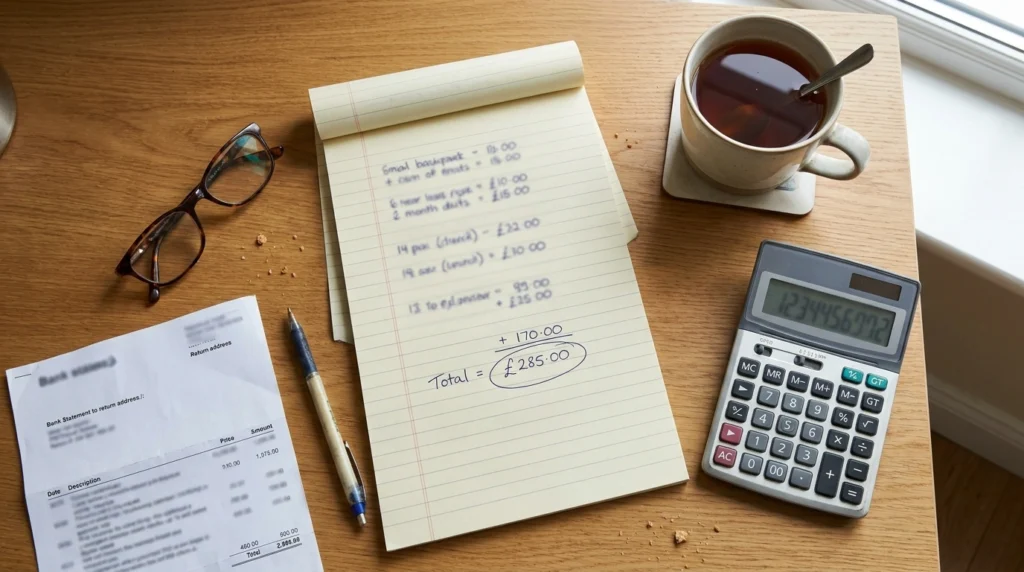
Take the balance of every account and every source of money on your zakat date, using statements dated that day.
Example: $4,000 in savings, $1,500 in checking, $500 in cash at home and $2,000 lent to a friend who is repaying. Total: $8,000.
Step 2: Subtract Debts Due Now
Deduct debts that are due immediately or within the coming period: this month’s rent, a credit card balance you will clear, an overdue bill, a personal loan instalment that is due.
Example: $800 in bills due now. $8,000 − $800 = $7,200.
Long-term loans, such as a 20-year mortgage or a car loan, are treated differently. Most contemporary scholars say you deduct only the instalments due in the coming twelve months (or, in a stricter view, only the payment due now), not the full outstanding balance. Deducting the whole mortgage is the most common reason people wrongly conclude they owe nothing.
Step 3: Compare Against the Nisab
Check whether your net figure meets or exceeds the nisab standard you follow.
Example: $7,200 is above the silver nisab of about $1,261. Zakat is due. (If you follow the gold standard, $7,200 is below about $12,200 and no zakat would be due on cash alone; this is why the choice of standard matters.)
Step 4: Multiply by 2.5%
Zakat on cash is 2.5% of your net eligible total.
Example: $7,200 × 0.025 = $180. That is your zakat on cash for the year.
Real-World Examples
Zakat on Salary and Savings
Zakat is not a tax on income. It is 2.5% of the wealth that survives the year. A person earning $150,000 who spends all of it owes nothing on cash; a person earning $45,000 who has saved $20,000 owes $500.
A common misunderstanding is that each paycheck must sit for a full year before it counts. In the Hanafi school, and in the practice most contemporary scholars recommend for simplicity, new income is merged with your existing wealth and you pay on the total balance held on your zakat date, including money that arrived last week. Tracking a separate hawl for every deposit, as the strictest reading of the Shafi’i school requires, is impractical for salaried people, and paying on the full balance is the safer and more generous position.
Zakat Across Multiple Accounts
You keep money in three banks and two apps. Do not test each against the nisab separately. Add every balance together first, then apply 2.5% to the combined total. Splitting money across accounts does not change what you owe.
Zakat on Money Lent to Others
You lent a friend $2,000 and expect repayment. Include it in your total if you are confident you will get it back. If repayment looks doubtful, you may leave it out and pay zakat on it when you actually receive it; some scholars then require zakat only for the year of receipt, others for the years missed. Ask a scholar you trust which view to follow.
Zakat on Savings for a House or Wedding
Money saved toward a house deposit, a wedding or Hajj is still your money. It counts in full. Zakat is due on it every year it sits above the nisab until it is spent.
Common Mistakes to Avoid
Using an out-of-date nisab. Silver and gold prices move; a nisab figure from a few years ago can be a third of today’s value. Check the price on your zakat date.
Deducting your entire mortgage or car loan. Subtract only the instalments due in the coming year, not the whole balance.
Testing each account separately. Add everything together first.
Forgetting the lunar year. Using the solar calendar means your zakat date drifts about 11 days later every year, so over time you pay less often than you should.
Ignoring small or dormant accounts. The old savings account with $300 in it still counts toward the total.
Excluding money that arrived recently. Pay on the balance you hold on your zakat date; you do not have to wait a year for each deposit.
Waiting for a “perfect” moment. Once your zakat date arrives and you are above the nisab, pay promptly. Delaying without reason is sinful in the view of the four schools.
Quick Calculation Formula
(Total cash and receivables on your zakat date − debts due now) × 2.5% = your zakat on cash
Apply it only if the net amount is at or above the nisab you follow. For a full worked household example that includes gold, investments and a retirement account, see how much is zakat and how to calculate zakat on gold.
Where Does Your Zakat Go?
Zakat must reach one of the eight categories named in the Quran in Surah At-Tawbah (9:60): the poor, the needy, zakat administrators, those whose hearts are to be reconciled, those in bondage, the debt-ridden, those in the path of God and stranded travellers. It cannot be given to your own dependents or to anyone whose needs are already met, and zakat given to someone who does not qualify must be repeated. Our explainer on what zakat is and who is eligible covers the categories in detail.
Many trusted charities distribute zakat on your behalf. Before giving, confirm that the organization verifies beneficiaries against the eight categories and publishes its accounts. Darul Infaq distributes zakat to verified low-income families through its financial assistance program, publishes its Form 990s and donation allocation policy, and accepts zakat through its Zakat-ul-Maal program.
Final Thoughts
Calculating zakat on cash comes down to three things: adding up every dollar you own on your zakat date, checking it against the current nisab, and paying 2.5% of the net amount. Once your zakat date is fixed, the process takes minutes each year.
If your situation also involves business stock, gold, shares or retirement accounts, the rules shift a little; the general calculation guide covers them, and a knowledgeable scholar can help with anything unusual. You now have everything you need to calculate zakat on your cash with confidence.
Calculated your zakat on gold? Pay it where it reaches those who qualify.
Give Your Zakat Now →Frequently Asked Questions About Zakat on Cash
What is the nisab for cash in 2026?
Nisab is fixed in metal: 612.36 grams of silver or 87.48 grams of gold. At September 2026 prices that is about $1,260 by the silver standard and about $12,200 by the gold standard. Check spot prices on your zakat date, because the dollar figure changes daily.
Do I pay zakat on my salary?
No, not on income as such. Zakat is 2.5% of the money you still hold on your zakat date. If you spend your whole salary every month and save nothing, you owe no zakat on cash. If you have saved, you pay on the saved balance, including money that arrived recently.
Do I have to hold each deposit for a full year before it counts?
Not in practice. In the Hanafi school, and in the approach most contemporary scholars recommend, new money is merged with your existing wealth and you pay on the total balance on your zakat date. Only the wealth as a whole needs to have been above the nisab for a lunar year.
Can I deduct my mortgage before calculating zakat on cash?
Only the instalments due in the coming year (or, in a stricter view, the payment due now), not the whole outstanding balance. Deducting the full mortgage is one of the commonest zakat errors.
Do I pay zakat on money I have saved for Hajj, a wedding or a house?
Yes. Earmarking money for a purpose does not remove it from your ownership. It counts in full every year it is above the nisab.
Do I pay zakat on money someone owes me?
Yes, if you are confident of getting it back. If repayment is doubtful, you may wait and pay when you receive it; ask a scholar whether to pay for the years missed.
Should I use the gold or silver nisab for cash?
The Hanafi school and many contemporary scholars use the silver nisab, which is lower and brings more people into the obligation. Others use gold. Choose one standard, apply it consistently, and if in doubt use silver, which is the more cautious and more generous choice.