Quick Answer
Zakat al-Fitr, also called Fitrana or Sadaqat al-Fitr, is an obligatory charity that every Muslim who has food or wealth beyond their basic needs must pay at the end of Ramadan, before the Eid al-Fitr prayer. It purifies the fast from its shortcomings and ensures that people in need can celebrate Eid with dignity. The amount is one sa’ of staple food per person, roughly 2.5 to 3 kg, or its cash value, which in the United States is usually set by mosques and charities at about $10 to $15 per person each year.
Zakat al-Fitr is one of the most important acts of worship in Islam. It connects personal spiritual practice to communal responsibility: the same act that completes your Ramadan puts food on a poor family’s table on Eid morning. Every Muslim who can afford it must pay it, on their own behalf and on behalf of their dependents, before the Eid prayer.
This guide explains exactly what Zakat al-Fitr is, who pays it, how much it costs, when to give it, who receives it, and how it differs from the annual Zakat on wealth.
Table of Contents
The Meaning and Origin of Zakat al-Fitr
The word zakat means purification and growth. Al-Fitr refers to breaking the fast, specifically the end of Ramadan. Together, Zakat al-Fitr means the charity of breaking the fast. Scholars also call it Sadaqat al-Fitr, and in South Asia and among many communities in North America it is simply known as Fitrana.
The Prophet Muhammad (peace be upon him) made Zakat al-Fitr obligatory before the Eid prayer. The companion Ibn Abbas (may Allah be pleased with him) narrated that the Prophet prescribed it “as a purification of the fasting person from idle talk and obscenities, and as food for the poor” (Sunan Abi Dawud, Hadith 1609). Another narration records that he ordered it to be paid before people go out to the Eid prayer (Sahih al-Bukhari, Hadith 1509).
This dual purpose, spiritual cleansing for the giver and food security for the poor, is what makes Zakat al-Fitr unique among Islamic obligations. It is an act of worship in Islam that cannot be completed alone; it is only complete when it reaches someone else. For a wider look at why giving sits at the heart of the faith, see our guide to the importance of charity in Islam.
Who Is Required to Pay Zakat al-Fitr?
Zakat al-Fitr is obligatory for every Muslim who, at the time it falls due, possesses food or wealth beyond what they and their dependents need for that day and night. Unlike Zakat on wealth, there is no minimum savings threshold (nisab) to meet in the majority view; if you have a day’s provision to spare, you pay.
The head of household pays on behalf of:
- Themselves
- Their spouse (in the majority view; in the Hanafi school a wife with her own means pays for herself, though a husband may pay on her behalf with her agreement)
- Their dependent children
- Any other dependents they support in the household
Age and gender do not affect the obligation. An infant is included if they were born before the time Zakat al-Fitr becomes due: at sunset on the last day of Ramadan according to the Shafi’i, Maliki and Hanbali schools, or at dawn on the day of Eid according to the Hanafi school.
You are exempt if you cannot afford it. If you do not have enough food or money beyond your household’s needs for Eid day, Zakat al-Fitr is not required of you; you are among those who should receive it.
How Much Is Zakat al-Fitr?
The Prophet (peace be upon him) set the amount at one sa’ of staple food per person. A sa’ is a measure of volume used in Madinah; converted to weight it equals roughly 2.5 to 3 kg of grain, depending on the food (a sa’ of dates weighs less than a sa’ of wheat). The Hanafi school allows half a sa’ when paying in wheat.
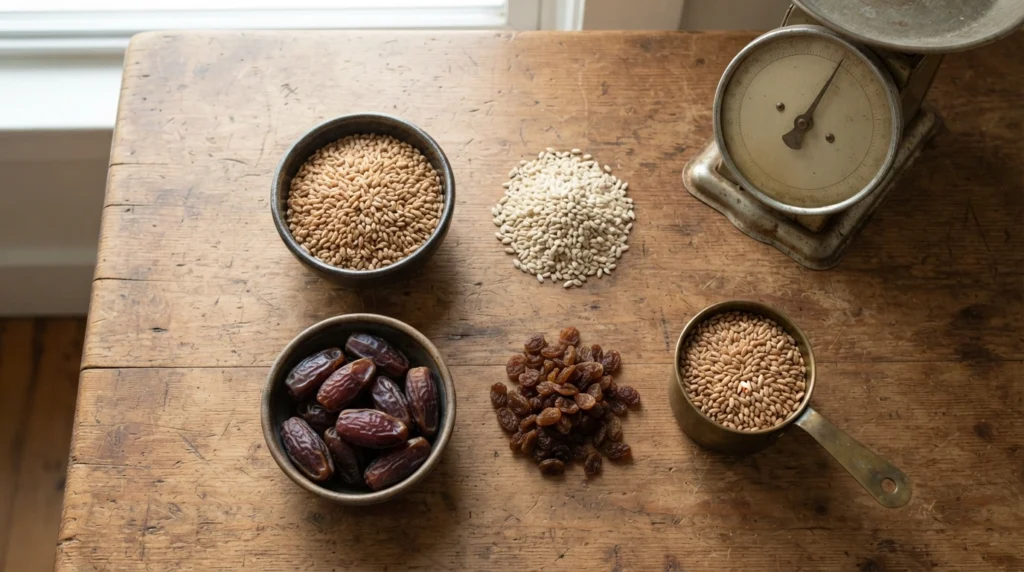
Traditionally, Muslims paid in the staple foods of their region:
- Dates
- Barley
- Wheat
- Raisins
- Rice or flour, in regions where these are the staple
Can it be paid in cash? The Hanafi school, and many contemporary scholars and Islamic organizations, permit paying the cash value of one sa’ of staple food, arguing that cash lets the poor buy what they actually need. The Maliki, Shafi’i and Hanbali schools traditionally hold that it should be given as food. Both positions are held by respected scholars; if you follow a school that requires food, paying through a charity that buys and distributes grain on your behalf satisfies that view while still being convenient. This is how Darul Infaq handles it: Fitrana funds are used to buy staple grains in bulk, which are distributed to verified families before Eid.
The cash amount varies by country and by the price of staple foods. Mosques and Islamic organizations publish a rate each year; in the United States it typically falls between $10 and $15 per person, and your local mosque’s figure should be followed. You can pay your Fitrana through Darul Infaq, which calculates the rate from the local market value of wheat, flour, rice or dates equivalent to one sa’.
When Should You Pay Zakat al-Fitr?
Timing matters. The Prophet (peace be upon him) ordered that Zakat al-Fitr be paid before people go out to the Eid prayer, because that is when it fulfills its purpose: the poor receive it in time to eat well on Eid.
Zakat al-Fitr paid after the Eid prayer, without a valid excuse, is still a debt that must be paid, but it loses the special reward; the Prophet described late payment as ordinary charity (Sunan Abi Dawud, Hadith 1609).
How early can you pay? The companions used to give it a day or two before Eid (Sahih al-Bukhari, Hadith 1511), and all schools accept this. The Hanafi and Shafi’i schools allow it to be paid earlier, even from the beginning of Ramadan, which is why charities open Fitrana collection during the month. Paying in the last ten days of Ramadan is the practical sweet spot: it is well within every school’s view, and it gives your mosque or charity time to buy food and distribute it before Eid morning.
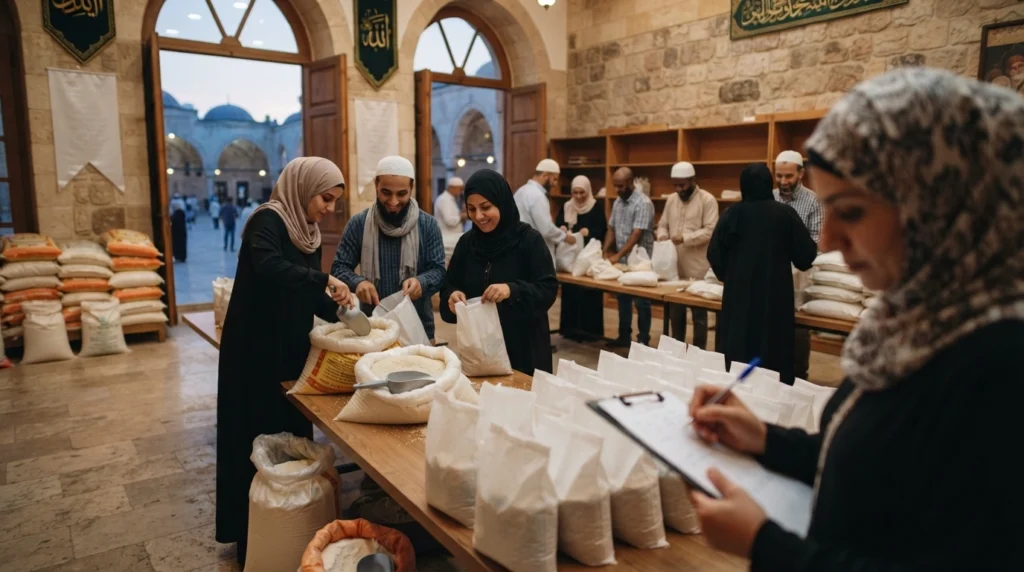
If you pay through an organization, confirm that it distributes before Eid. Charities such as Darul Infaq run an advance system for exactly this reason: funds collected during Ramadan are converted into grain and allocated to pre-vetted families in the final days of the month.
Who Receives Zakat al-Fitr?
The hadith names its recipients directly: it is “food for the poor”. The poor and the needy (al-fuqara’ wal-masakin) are the primary recipients in every school. The Maliki school and some Hanbali scholars restrict it to these two groups, while the Hanafi and Shafi’i schools allow it to be given to any of the eight categories of Zakat recipients named in the Quran (9:60). In practice, almost all Zakat al-Fitr is given to the poor and needy, and that is the safest choice.
The purpose is that no Muslim spends Eid worrying about food. Families who rely on daily wages, widows, orphans and the elderly are the people the Prophet had in mind.
Many scholars recommend giving Zakat al-Fitr locally first, so that it reaches people in your own community before Eid morning. If local needs are met, or if your organization can guarantee delivery before Eid, it may be sent to communities in greater need elsewhere. Darul Infaq distributes Fitrana as food staples to verified low-income households, alongside its Ramadan Ration Drive and Eid-ul-Fitr Packs, so that the same families are fed through the month and on the day itself.
Zakat al-Fitr vs Zakat al-Mal: What Is the Difference?
The two are often confused because they share a name. They are separate obligations with different rules.
| Zakat al-Fitr (Fitrana) | Zakat al-Mal (Zakat on wealth) | |
| What it is | Charity due at the end of Ramadan | Annual charity on accumulated wealth |
| Who pays | Every Muslim with a day’s provision to spare, including for dependents | Muslims whose wealth exceeds the nisab for a full lunar year |
| Amount | One sa’ of staple food per person, or its cash value (about $10 to $15 in the US) | 2.5% of qualifying wealth (cash, gold, silver, business stock, investments) |
| When | Before the Eid al-Fitr prayer | On your Zakat anniversary, whenever in the year that falls |
| Recipients | The poor and needy (some schools allow all eight Quranic categories) | The eight categories in Quran 9:60 |
| Paid on behalf of others | Yes, the head of household pays for dependents | No, each person pays on their own wealth |
Paying one does not discharge the other. Someone whose wealth is below the nisab still owes Zakat al-Fitr, and someone who paid Zakat al-Fitr still owes Zakat al-Mal on their savings. Our guides explain what Zakat is and who is eligible, when Zakat is due and how to calculate Zakat; you can give your annual Zakat through our Zakat-ul-Maal program.
Zakat al-Fitr is also distinct from Fidya, the compensation paid by those who cannot fast at all for medical or age reasons, and from Kaffarah, the penalty for deliberately breaking a fast. See our guide to Fidya for missed fasts.
Why Zakat al-Fitr Matters
Zakat al-Fitr is a small act with a profound impact.
For the giver, it purifies the fast. A month of fasting includes moments of careless speech, distraction and shortcoming. Zakat al-Fitr is an act of closure, a way of submitting the fast in a more complete state.
For the receiver, it guarantees a dignified Eid. Around two billion Muslims celebrate Eid al-Fitr each year, and Zakat al-Fitr is the mechanism that ensures the celebration is not reserved for those with means.
Collectively, it builds social cohesion. Because it is due from almost everyone, including on behalf of children, it teaches each generation that worship is never purely individual; every act of obedience carries a social dimension. For a neutral historical overview, the Wikipedia entry on Zakat al-Fitr summarizes how the practice developed across the Muslim world.
Frequently Asked Questions About Zakat al-Fitr
What is the difference between Zakat al-Fitr and Zakat al-Mal?
Zakat al-Fitr is a fixed amount (one sa’ of food or its cash value) paid at the end of Ramadan by every Muslim who can afford it, including on behalf of dependents. Zakat al-Mal is 2.5% of wealth above the nisab held for a full lunar year, paid on your own Zakat anniversary. They have different amounts, timings and recipient rules, and paying one does not discharge the other.
Can I pay Zakat al-Fitr in cash instead of food?
The Hanafi school and many contemporary scholars permit paying the cash value of one sa’ of staple food. The Maliki, Shafi’i and Hanbali schools traditionally require food. Giving through a charity that buys and distributes grain on your behalf satisfies both views.
How much is Zakat al-Fitr in the US?
Most US mosques and Islamic charities set the rate between $10 and $15 per person per year, based on the local cost of one sa’ (about 2.5 to 3 kg) of a staple food. Follow the figure published by your local mosque or the charity you pay through.
What happens if I forget to pay Zakat al-Fitr before Eid prayer?
You still owe it and should pay it as soon as possible; the obligation does not lapse. However, payment after the Eid prayer without a valid excuse loses the special reward and is counted as ordinary charity. Pay in the last days of Ramadan to avoid this.
Do I pay Zakat al-Fitr for a baby born during Ramadan?
Yes, if the baby was born before the time it becomes due: sunset on the last day of Ramadan in the Shafi’i, Maliki and Hanbali schools, or dawn on Eid day in the Hanafi school. The head of household pays on the infant’s behalf.
Is Zakat al-Fitr required for non-Muslim household members?
No. It is only due on behalf of Muslim members of the household. Non-Muslim relatives may, however, be given ordinary charity.
Is Fitrana the same as Zakat al-Fitr?
Yes. Fitrana is the Urdu and South Asian name for Zakat al-Fitr, and Sadaqat al-Fitr is another Arabic name for the same obligation. All three refer to the charity paid before the Eid al-Fitr prayer.
Calculated your zakat on gold? Pay it where it reaches those who qualify.
Give Your Zakat Now →