
| Quick answer Zakat becomes due once you have held wealth above the nisab threshold for one complete lunar year. That completed year is called the hawl, and the day it ends is your zakat anniversary date. The date is personal to you. It is not a national date, not a fixed day in the calendar, and not automatically Ramadan. If your wealth first crossed nisab on 15 Shawwal, then 15 Shawwal is your due date every year that you remain above the threshold. |
Most people asking when zakat is due are expecting a date they can write in a diary. There is one, but you have to work it out yourself, because the answer depends on your own wealth history rather than on a shared calendar. Zakat is tied to a personal twelve month cycle, and knowing where you are in that cycle matters before you start how to calculate what you owe.
The cycle starts on the day your total zakatable wealth first rose above the nisab threshold. From that moment a clock begins. When one lunar year has passed and you are still above the threshold on that day, zakat becomes payable on whatever you hold at that point. Not on your average balance for the year, and not on the peak.
Zakat is due on your date, not on a shared national date
There is no single day of the year on which the Muslim community collectively owes zakat. A person who crossed nisab in Rajab owes in Rajab. A person who crossed it in Dhul Hijjah owes in Dhul Hijjah. Two people in the same household can easily have two different dates, and both are correct.
This surprises people because the visible signs point the other way. Charity appeals peak in Ramadan, mosques run zakat drives in Ramadan, and reminders arrive in Ramadan. That is a pattern of donor behaviour, not a ruling about the deadline.
How to work out your hawl if you never recorded one
Most people never noted the day their savings first passed nisab, and that is normal. You are not required to reconstruct it with forensic accuracy. What matters is that you settle on a reasonable date, then keep it consistently. Three practical routes:
- Reconstruct it from bank records. Look back through statements for the month your balance first sat comfortably above the nisab figure and did not fall back below it. Use the first day of that month.
- Use your best honest estimate. If the records are gone, pick the month you genuinely believe it happened and treat that as your anniversary from now on.
- Set it deliberately from today. If you have never paid and cannot establish a starting point, choose a memorable Hijri date, pay on the assumption the year is already complete, and run every future year from that date.
Whichever route you take, write the Hijri date down somewhere you will find it again. The commonest reason people lose track a second time is that they solved the problem mentally and never recorded the answer.

Your date moves through the Gregorian calendar every year
This is the part that catches out anyone using a Gregorian reminder. The hawl runs on the Hijri calendar, which is roughly 354 days rather than 365. A fixed Hijri date therefore lands about eleven days earlier in the Gregorian year each time it comes around. Setting a recurring reminder for 24 March will be wrong within twelve months.
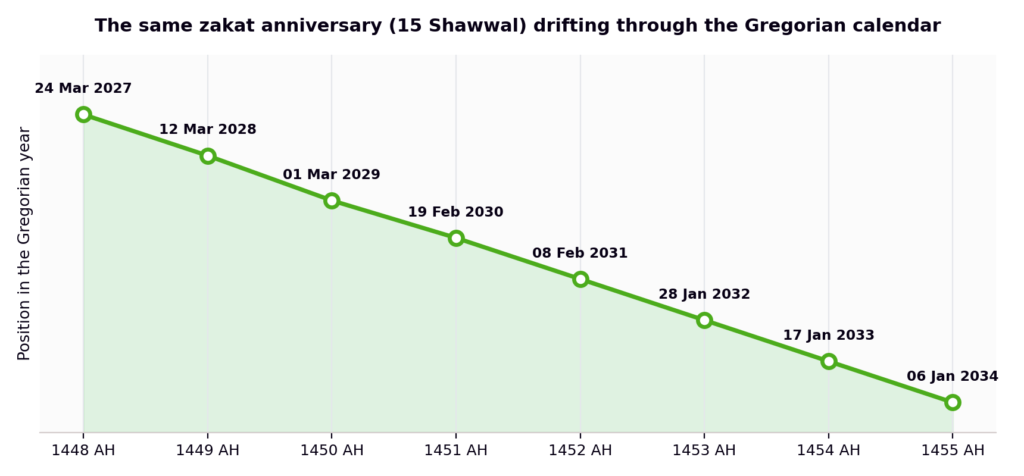
A zakat anniversary fixed at 15 Shawwal, shown against the Gregorian calendar across eight lunar years.
| Hijri year | 15 Shawwal falls on | Shift from previous year |
| 1448 AH | 24 March 2027 | reference year |
| 1449 AH | 12 March 2028 | 12 days earlier |
| 1450 AH | 1 March 2029 | 11 days earlier |
| 1451 AH | 19 February 2030 | 10 days earlier |
| 1452 AH | 8 February 2031 | 11 days earlier |
| 1453 AH | 28 January 2032 | 11 days earlier |
| 1454 AH | 17 January 2033 | 11 days earlier |
Dates are calculated conversions and may vary by a day depending on local moon sighting.
The practical consequence is simple. Track your zakat date in Hijri terms and convert it each year, rather than fixing it to a Gregorian day and letting it slide out of alignment.
What happens if your wealth moves during the year
A frequent worry is that dipping below nisab mid year resets everything, or that every new deposit starts its own separate clock. Neither is how the majority position works in practice. The table below covers the four situations that come up most often. If you want the mechanics of the rate itself rather than the timing, that sits with the 2.5 percent rule, and the wider obligation is covered in our explainer on what zakat is and why it is owed.
| Situation | Effect on your hawl | What you pay |
| Wealth dips below nisab briefly, then recovers | The year continues. Most scholars look at the start and end of the hawl, not every day in between. | Pay on the total held on your anniversary date. |
| Wealth stays below nisab on the anniversary itself | The cycle ends. A new hawl begins when you next cross the threshold. | Nothing is owed this year. |
| You add new savings in month eight | No separate clock. The new money joins your existing pool. | Pay on the combined total on your date. |
| Your wealth grows substantially through the year | The date does not change. | Pay on the higher figure held on the date, not the earlier one. |
Paying early is allowed, and often sensible
You may pay zakat in advance of your anniversary. This is a settled allowance, and it is what makes Ramadan payment possible for people whose real date falls elsewhere. Many donors choose Ramadan for the reasons set out in our piece on why Ramadan carries so much weight, and there is nothing wrong with that so long as the accounting is honest.
Two conditions keep an early payment clean. Your wealth must already be above nisab when you pay, and you must still reconcile on your actual date. If the figure owed on your anniversary turns out higher than what you paid in advance, the difference is still due. Paying early moves the timing forward. It does not cap the amount.
Paying late: what you owe and what you do not
Zakat does not expire. A year you missed remains a debt until it is discharged, and delaying it does not reduce it. This is worth saying plainly because the alternative belief, that missed years quietly lapse, is both common and wrong.
For each missed year you owe the amount that was due on that year’s anniversary, based on the wealth you held then rather than what you hold now. If the records for an old year are gone, a careful estimate made in good faith is accepted. Estimate slightly high rather than slightly low: overpaying counts as voluntary charity, while underpaying leaves part of the obligation outstanding.
What you do not owe is a penalty or interest. There is no surcharge for lateness in zakat. The obligation is the original amount, nothing added on top.
A simple way to track your zakat date every year
- Fix the Hijri date. Record the day and month, for example 15 Shawwal, not its Gregorian equivalent.
- Set two reminders. One a month ahead so you can gather figures without rushing, and one on the day itself.
- Keep a single running note. Record the date, the total wealth you counted, and the amount paid. Ten minutes a year removes the reconstruction problem permanently.
- Decide in advance where it goes. Eligibility is narrower for zakat than for voluntary giving, which is the core of zakat compared with sadaqah.
If your anniversary has arrived, or you are clearing a year you missed, you can pay your zakat through our Zakat ul Maal fund, which is open all year and not only during Ramadan. Every payment is distributed strictly within the eight Quranic categories, and you can give through the donation form in a couple of minutes. If you want to see where funds went before you give, our published financial reports set it out.
Frequently asked questions
When is zakat due?
Zakat is due once you have owned wealth above nisab for one full lunar year. The day that year completes is your zakat anniversary date, and it is personal to you rather than fixed for everyone.
Do I have to pay zakat in Ramadan?
No. Ramadan timing is a widespread habit, not a deadline. If your hawl completes in another month, that month is your due date. You may still choose to pay early in Ramadan if you prefer.
How do I find my zakat anniversary date if I never recorded one?
Check bank statements for when your balance first passed nisab and stayed there, or make an honest estimate of that month. If neither is possible, set a Hijri date deliberately and use it consistently from now on.
Why does my zakat date move in the Gregorian calendar?
Because the hawl follows the Hijri calendar, which runs about eleven days shorter than the Gregorian year. A fixed Hijri date therefore arrives about eleven days earlier each Gregorian year.
What do I owe for missed zakat from previous years?
You owe the amount that was due in each missed year, calculated on the wealth you held at that time. No penalty or interest is added. Where records are incomplete, estimate carefully and lean slightly high.