Quick Answer
Can you listen to music during Ramadan? In the narrow sense, yes. Listening to music does not break your fast. Nothing reaches your stomach, and music is not one of the things that invalidates a fast.
Whether music is permitted at all is a separate question, and scholars disagree. Some hold instruments forbidden, others permit them. Ramadan does not change the ruling, but most scholars still advise cutting back.
Ask ten Muslims “can you listen to music during Ramadan” and you will get ten different answers. This post separates the two questions people usually mix together: does music break your fast, and is music allowed in the first place?
Table of Contents
- Can You Listen to Music During Ramadan Without Breaking Your Fast?
- Why Is There a Debate About Music in Islam?
- What Is the Stricter Position on Music?
- What Is the Permissive Position on Music?
- Why Do Scholars Advise Cutting Back on Music in Ramadan Anyway?
- What Can You Listen to Instead During Ramadan?
- Frequently Asked Questions
Can You Listen to Music During Ramadan Without Breaking Your Fast?
Can you listen to music during Ramadan and keep a valid fast? Yes. A fast is broken by specific things: eating, drinking, marital intimacy during fasting hours, and deliberately vomiting. Listening to something is not on that list, and no school of thought counts it as a nullifier. If a song comes on in a shop or a car radio while you are fasting, your fast is still valid.
There is a difference, though, between a fast that is valid and a fast that earns its full reward. A hadith in Sahih al-Bukhari says whoever does not give up false speech and acting on it should know Allah has no need of him giving up his food and drink. The fast counts. The reward can shrink. The full rules of Ramadan set out what invalidates a fast and what only weakens it.
Why Is There a Debate About Music in Islam?
The Quran never names music directly. No verse forbids it by name, and none permits it either, so scholars have argued for over a thousand years about the indirect evidence.
The verse most often quoted is in Surah Luqman, 31:6, which criticises those who buy “idle talk” to mislead people from the path of Allah. Some early commentators, including the companion Abdullah ibn Masud, understood “idle talk” to mean singing. Others read it more broadly, as a warning against anything that distracts from faith. Then there is a hadith in Sahih al-Bukhari in which the Prophet (peace be upon him) is reported to have said that some people would treat as lawful unlawful sexual relations, silk for men, wine, and musical instruments. Stricter scholars treat this as a clear prohibition. Permissive scholars question the chain of the narration, or argue it targets music tied to drinking and immorality, not all music.
What Is the Stricter Position on Music?
The stricter position is the majority view across the four Sunni schools: musical instruments are forbidden, with a narrow exception for the duff, a simple hand drum, at weddings and Eid. The evidence is the Bukhari hadith above, the reading of Luqman 31:6 as singing, and an argument about effect: music stirs desire and distracts from the remembrance of Allah.
Under this view, the voice alone is treated differently from instruments. Nasheed, sung praise without instruments, is widely accepted, and even many strict scholars allow the duff at celebrations. What they object to is instruments as a category, and most strongly when the lyrics celebrate drinking, lust or violence. So can you listen to music during Ramadan under the stricter view? No, at least not with instruments. Note that this position does not claim music breaks a fast. It claims only that listening may be a sin in itself.
What Is the Permissive Position on Music?
The permissive position has a long history of its own. The scholar Ibn Hazm, writing in the eleventh century, argued that the Bukhari narration about instruments had a broken chain and could not support a prohibition. Others accepted the narration but read it as a warning about a specific kind of gathering, one where music, wine and immorality came together, rather than a ban on every instrument. Modern scholars who permit music add conditions: clean lyrics, no distraction from prayer or duties, and no link to drinking, gambling or anything else forbidden.
Under those conditions, the late scholar Yusuf al-Qaradawi argued that music is permissible, pointing to a well known incident. On a day of Eid, two young girls were singing in the home of Aisha, with a duff, while the Prophet (peace be upon him) was present. Abu Bakr objected, calling it the music of Satan in the Prophet’s house. The Prophet told him to leave them alone, saying every people have a festival, and this is ours. Permissive scholars read this as tolerance of some music in the Prophet’s presence. Stricter scholars read it as allowing only the duff and innocent singing on Eid, which they already accept.
| Position | View on instruments | Key evidence | What it allows |
|---|---|---|---|
| Stricter (majority of the four schools) | Forbidden, except the duff on occasions | Bukhari hadith on instruments; Luqman 31:6 read as singing | Voice-only nasheed, duff at weddings and Eid |
| Permissive (Ibn Hazm, al-Qaradawi and others) | Permitted if clean and not distracting from duties | Eid singing incident in Bukhari; questions over the prohibition hadith’s chain | Instruments and singing with clean lyrics, within limits |
Why Do Scholars Advise Cutting Back on Music in Ramadan Anyway?
Even scholars who permit music usually tell you to cut back in Ramadan. The disagreement about the ruling does not carry over into advice for the month, because Ramadan is not only about what breaks your fast. It is about what the fast is for.
The Quran gives the purpose in one line: fasting is prescribed “so that you may attain taqwa”, conscious awareness of Allah (2:183). That is a higher bar than validity. A fast can be valid and still miss the point, when music takes the attention the month asks you to give to the Quran, to prayer and to giving. Read more about why Muslims fast at all and why Ramadan matters beyond the dates.
There is also a practical side. Music fills the commute, the workout, the cooking, the evening scroll. If your playlist is the soundtrack of your day, swapping some of it for recitation or a lecture changes the feel of the month more than almost any other single habit. That is why the advice, for anyone asking can you listen to music during Ramadan, is so consistent: cut back. It is not about the ruling. It is about the month.
What Can You Listen to Instead During Ramadan?
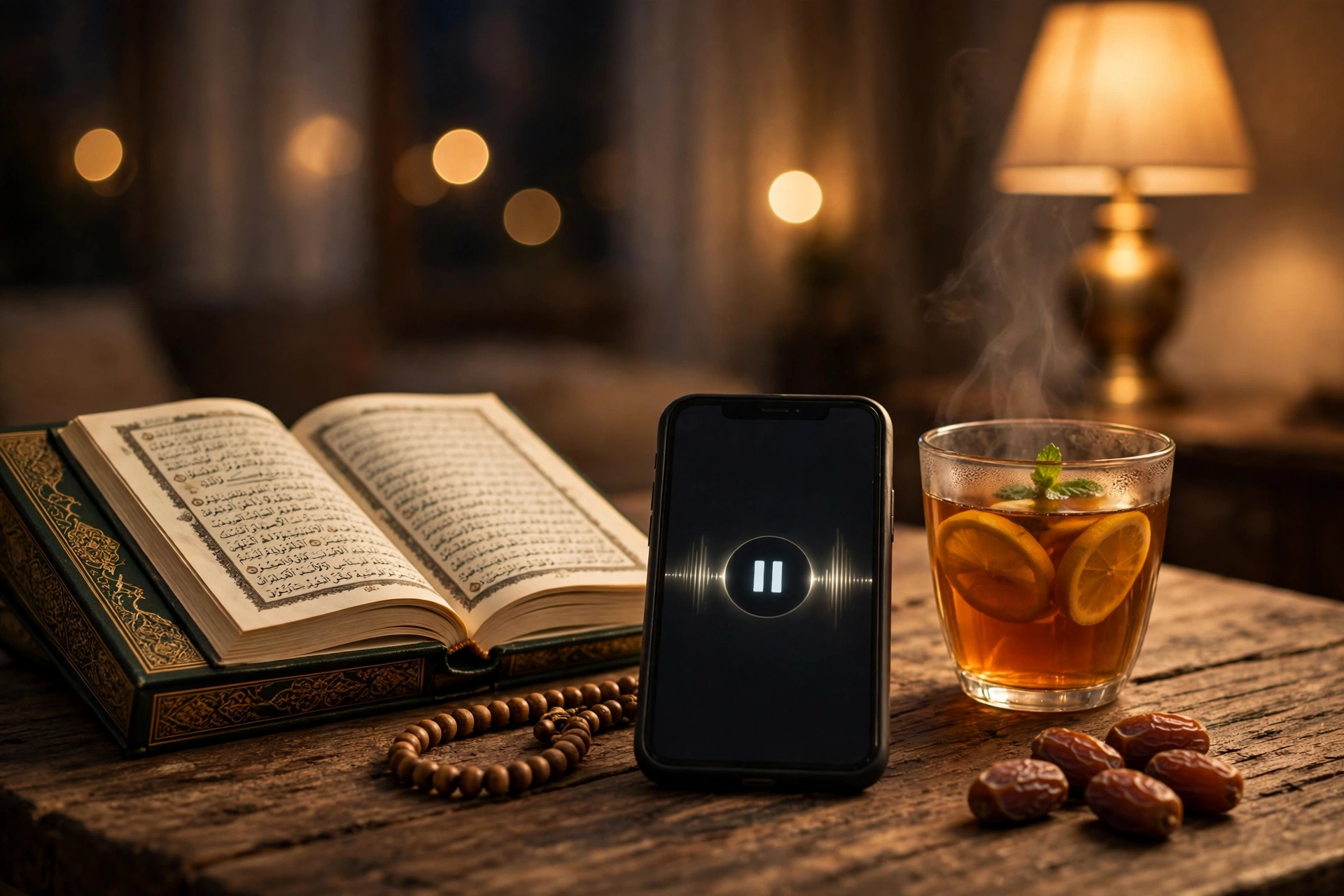
The simplest swap is nasheed: sung praise of Allah and the Prophet (peace be upon him), without instruments, accepted across almost all positions. Many people who would never give up music entirely find nasheed an easy replacement for a month.
Quran recitation is the other obvious choice. Taraweeh runs through the Quran over the month, and if you usually listen to music on a commute, a reciter you enjoy can take that same slot. Podcasts and lectures fill the same gap too. The point is not to replace one habit with an identical one. It is to give the month a different sound.
Whatever you cut back on this month, redirect some of it. Your Ramadan gift can put food on a family’s table for the evening meal.
Give Your Zakat Now →Frequently Asked Questions
Can you listen to music during Ramadan?
Listening to music does not break your fast, but whether music is permitted at all is debated. The stricter position forbids instruments, the permissive position allows clean music, and most scholars advise cutting back either way.
Does listening to music break your fast?
Can you listen to music during Ramadan without breaking your fast? Yes. A fast is broken by eating, drinking, marital intimacy during fasting hours, and a few other specific acts. Listening to music is not one of them. It may reduce the reward, but the fast remains valid.
Is nasheed allowed during Ramadan?
Yes, in almost every scholarly view. If you are asking can you listen to music during Ramadan and want a safe choice, nasheed is it: vocal praise without instruments, widely accepted even by scholars who forbid instruments.
Can you listen to music after iftar?
The fast being over does not change the ruling. The same debate applies at night, and scholars who advise cutting back mean the whole month, not only the fasting hours.
Is listening to Quran better than listening to music in Ramadan?
Yes, and there is no disagreement on this. Ramadan is the month of the Quran, and taraweeh is built around hearing it recited. Swapping even part of your usual listening for recitation makes the month feel different.
Whatever you cut back on this month, redirect some of it – our Ramadan appeal is open.