Quick Answer
Relative poverty means living on a household income well below the typical income in your own country. It is usually measured as less than 60% of the national median household income (the EU and UK standard), while the OECD commonly uses 50%. Unlike absolute poverty, it doesn’t ask whether you can survive. It asks whether you can afford the ordinary standard of living most people around you take for granted.
You’ve probably heard “poverty” used in different ways depending on the context, and that inconsistency isn’t accidental. Relative poverty and absolute poverty measure genuinely different things, and mixing them up leads to confusing comparisons between countries or time periods.
Below, we explain exactly what relative poverty means, how it’s measured, and why the same income can count as poverty in one country but not in another.
Table of Contents
Relative Poverty Definition
Relative poverty describes a situation where a household’s income is so far below the typical income of its society that it cannot fully take part in normal social and economic life. In practice, it is measured using a percentage of the national median household income, adjusted for household size (often called “equivalised” income).
The exact cut-off depends on who is measuring:
- 60% of median income is the standard used by the European Union (its “at-risk-of-poverty” rate) and the UK government.
- 50% of median income is the threshold most often used by the OECD for international comparisons.
- 40% of median income is sometimes used to identify deeper or more severe relative poverty.
Because the threshold is tied to how the whole population is earning rather than a fixed dollar or pound amount, it is recalculated whenever new income data is published, usually every year. If median income rises across a country, the relative poverty line rises with it, even if the actual cost of essentials hasn’t changed much.
For a deeper academic overview of the concept and its history, see the relative poverty entry on Wikipedia.
Relative Poverty vs. Absolute Poverty
This distinction trips a lot of people up, so it’s worth being specific.
Absolute poverty measures whether someone can afford the basic necessities for survival, such as food, clean water, and shelter, using a fixed standard. The best-known example is the World Bank’s international extreme poverty line, which was updated in June 2025 to $3.00 per person per day (in 2021 purchasing power parity terms). Individual countries also set their own national absolute poverty lines, which differ from place to place.
Relative poverty measures whether someone’s income allows them to participate in the normal life of their specific society, using a moving benchmark tied to that society’s median income.
| Absolute Poverty | Relative Poverty | |
| What it measures | Ability to meet basic survival needs | Income compared with the rest of society |
| Benchmark | Fixed line (e.g. $3.00/day internationally) | Share of median income (usually 50% or 60%) |
| Changes over time? | Only adjusted for prices/inflation | Moves as median income moves |
| Most relevant in | Low-income countries | Middle- and high-income countries |
| Mainly tracks | Deprivation | Inequality and social exclusion |
A household earning $15,000 a year is far above the World Bank’s extreme poverty line, which works out to roughly $1,095 per person per year. But in a wealthy country where the median household income is $60,000, the 60% relative poverty line would sit at $36,000, so that same $15,000 household would clearly be in relative poverty.
If you want to understand what actually helps people escape both forms of poverty, read our guide on how to fix poverty and what the evidence shows.
Why Median Income Matters More Than Average Income
Relative poverty calculations use median income rather than average (mean) income, because the median isn’t skewed by a small number of extremely high earners.
If a handful of billionaires live in a country, the average income gets pulled up dramatically, even though most people earn far less. The median, the middle value when everyone’s income is lined up in order, gives a much more realistic picture of what a typical household actually earns.
A Practical Example of Relative Poverty
Imagine a country where the median household income is $50,000 a year. The relative poverty line at 60% of median income would be $30,000, so any household earning below that amount is classified as living in relative poverty, regardless of whether $30,000 would be considered a good income somewhere else.
Now imagine a different country where the median household income is $20,000 a year. The relative poverty line there would be $12,000. That’s a much lower figure in dollar terms, even though it represents exactly the same relative position within that society.
This is why comparing “poverty rates” between countries without checking whether they use relative or absolute measures can be misleading.
What Relative Poverty Looks Like Day to Day
Relative poverty often means being able to cover basic needs like food and shelter, but struggling to afford things most people in your society take for granted, such as:
- Reliable transportation to get to work or school
- Joining social activities, birthdays, or celebrations without financial strain
- Keeping up with clothing or technology considered standard in your community
- Taking any kind of holiday or time off that involves spending money
- Handling unexpected costs, like a car repair or a medical co-pay, without going into debt
This is why relative poverty is often described as a measure of social exclusion as much as financial hardship. It’s less about starving and more about being consistently unable to keep pace with everyone around you. For many families, one unexpected bill is enough to tip a tight budget into crisis, which is why short-term financial assistance and monthly grocery support can make such a difference.
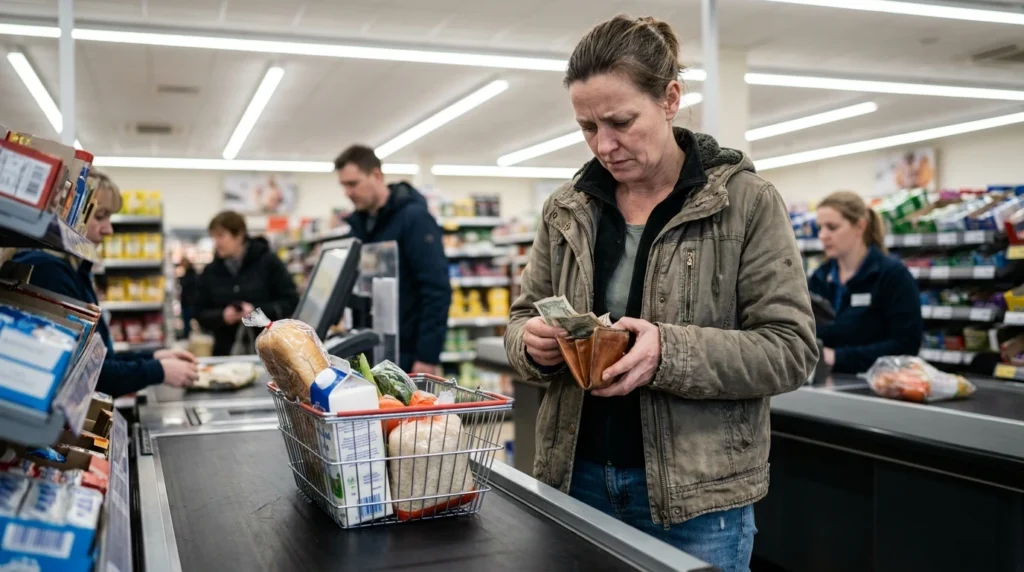
Children feel this gap too. School trips, books, uniforms, and exam fees add up quickly, and falling behind peers can affect a child’s future earnings. Programs like educational assistance help break that cycle before it becomes generational.
Why Relative Poverty Matters for Policy
Governments track relative poverty because it captures inequality within a society, not just whether people are meeting a bare survival minimum.
A country can largely eliminate absolute poverty while still having significant relative poverty if income inequality remains high. This is common in wealthier nations, where very few people lack basic food or shelter, but a meaningful share of the population still falls well below the median income. Even the World Bank now publishes a “societal poverty line” alongside its extreme poverty line, recognising that what counts as poor rises as countries get richer.
Long-term solutions usually focus on raising the income and skills of lower-income households, which is the idea behind self-reliance projects that help families build a stable livelihood instead of depending on aid.
Criticisms of the Relative Poverty Measure
Some economists argue relative poverty can rise even when everyone’s actual living standards improve, simply because median income moved up faster than lower incomes did.
The reverse can also happen. During a recession, median income may fall, pulling the relative poverty line down with it. Relative poverty can then appear to fall even though lower-income households are no better off, and may actually be worse off.
This can be confusing without understanding how the measurement works. It’s a valid critique, but it doesn’t make the measure meaningless. It simply means relative poverty tracks inequality and relative living standards, not absolute improvement. That’s why most statistical agencies publish relative and absolute measures side by side.
Which Countries Use This Measure?
Relative poverty is the headline measure across the European Union and in many OECD countries. The UK reports both relative and absolute low-income figures, with relative poverty (60% of median income) the most widely quoted.
The United States has historically relied on an absolute measure: the Official Poverty Measure, a fixed income threshold adjusted only for inflation. Since 2011, the US Census Bureau has also published the Supplemental Poverty Measure, which updates its thresholds based on what families actually spend on essentials.
These differences partly explain why poverty statistics can look wildly different between countries even when living standards are broadly comparable.
Calculated your zakat on gold? Pay it where it reaches those who qualify.
Give Your Zakat Now →Frequently Asked Questions About Relative Poverty
What is relative poverty in simple words? Relative poverty means having much less income than most people in your own country, usually below 50% or 60% of the median income, so you can’t afford the normal standard of living around you.
What is the difference between relative and absolute poverty? Absolute poverty is about not having enough for basic survival needs, measured against a fixed line. Relative poverty is about falling far behind the typical income in your society, measured against a moving line based on median income.
How is relative poverty measured? It is usually measured as the share of households living below 60% (EU and UK) or 50% (OECD) of the national median household income, adjusted for household size.
Can relative poverty ever be eliminated? In theory, yes. If incomes were distributed evenly enough that no household fell below 60% of the median, relative poverty would be zero. In practice, it can be reduced significantly through lower inequality, stronger safety nets, education, and employment support.
Is relative poverty common in rich countries? Yes. Relative poverty is the main form of poverty in high-income countries, where absolute poverty is rare but income inequality can still leave many families struggling to keep up.
How You Can Help Families Facing Poverty
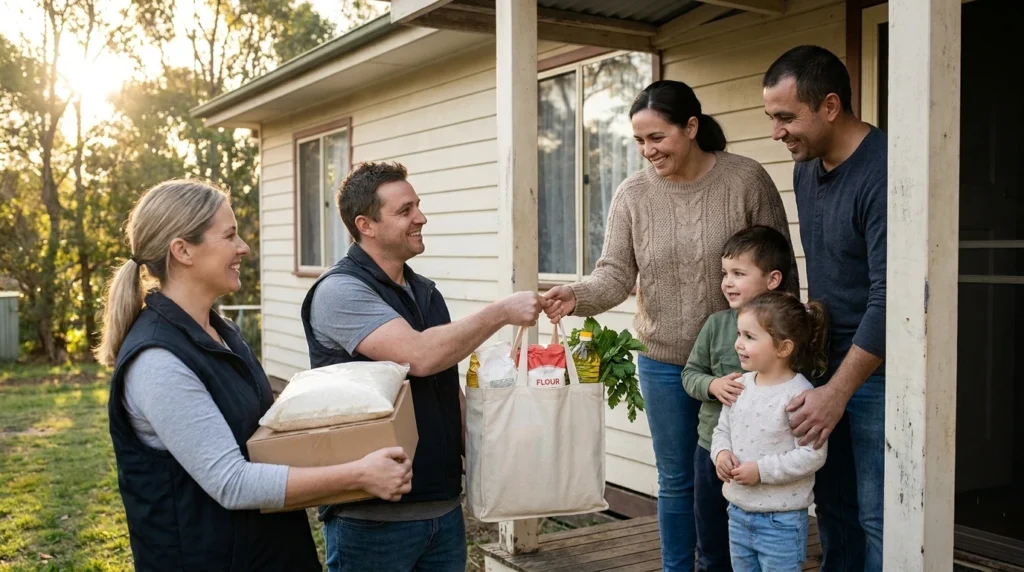
Whether poverty is absolute or relative, the families living through it face real hardship every day. At Darul Infaq Foundation, we support vulnerable households locally and internationally through fresh meals, monthly groceries, emergency cash support, education funding, and livelihood projects. You can also direct your Zakat-ul-Maal to eligible families. Not sure if you qualify to give or receive? Read our guide on who is eligible for Zakat.Ready to make a difference?Donate now and help a family move from hardship toward stability.