Quick Answer
What is Ramadan for kids? Ramadan is a special month when Muslims fast from dawn to sunset, pray more, and give to people who need help. Children do not have to fast. They join in by helping at home, learning to share, and counting down the days to Eid.
The month lasts 29 or 30 days, and the date moves each year because the Islamic calendar follows the moon. Ramadan 2027 is expected to begin on Monday, 8 February, and Eid al-Fitr is expected on Tuesday, 9 March.
Keep it simple when you explain it. Ramadan is a month for being kind, patient, and grateful. A child who understands that much already understands the heart of it.
If you are wondering what is Ramadan for kids, start with the short version. Ramadan is the ninth month of the Islamic calendar, and it is the month when Muslims fast. From dawn until sunset, grown-ups do not eat or drink, not even water. Then the family eats together at sunset, and that meal is called iftar. The month ends with Eid al-Fitr, a day of celebration, new clothes, and gifts for children.
- What Is Ramadan for Kids? Explaining It in Words a Five-Year-Old Will Follow
- What Do You Say When a Child Asks Why You Are Not Eating?
- What Are Half-Day Fasts and Other Gentle First Steps?
- How Can You Make the Month Feel Like an Occasion at Home?
- How Does a Simple Good-Deeds Chart Work?
- What Should Teachers Know If a Pupil Is Fasting?
- Frequently Asked Questions
What Is Ramadan for Kids? Explaining It in Words a Five-Year-Old Will Follow
A five-year-old does not need theology. She needs a picture she can hold in her mind, and three or four sentences she can repeat back to you.
Try something like this. Ramadan is a special month, like a birthday month for the whole family. Grown-ups skip food and water during the day to remember God and to think about people who do not have enough to eat. When the sun goes down, everyone eats together. At the end of the month there is a big party called Eid. That is enough for a young child. You can add detail later, when she asks for it, and she will.
It also helps to give Ramadan a shape a child can see. The month follows the moon, so you can watch the crescent together on the first evening and count the nights. A paper chain with 29 or 30 links works well. Take one off each evening after iftar. That is what is Ramadan for kids in practice: something they can touch and count.
If she asks why, say, “We do it because God asked us to, and because it helps us remember people who are hungry.” Read more about why Ramadan is important when your child is old enough to ask for the bigger reasons.
One more thing matters. Do not make Ramadan sound like a punishment. Children copy the tone they hear. If you talk about it as the month when the house smells of cooking at sunset and the family sits down together, they will look forward to it.
What Do You Say When a Child Asks Why You Are Not Eating?
Every parent hears this question, usually at breakfast, when a child is eating cereal and you are not. The answer does not need to be long. It needs to be honest and calm.
Say this: “In Ramadan, grown-ups do not eat or drink during the day. We eat before the sun comes up and again after it goes down. It is part of how we worship God.” Then stop. Most children accept that and move on. Some children worry, and think you are ill. Tell them you are fine. “I am a bit hungry sometimes, and that is alright. It reminds me to be grateful for food.”
A harder question follows in many homes: “Why can’t I fast too?” Children want to join in. Tell them fasting is for grown-ups, and that their turn will come when they are older. Then give them something of their own to do. A child who helps set the iftar table, or who puts a coin in the charity box each day, is not left out. That is the whole of what is Ramadan for kids for a young child: a short answer, honestly given, and a small part to play.
If a child keeps pressing, be plain about the rule. Fasting becomes obligatory at puberty, not at a set age, and young children are not expected to fast at all. Some children try a short fast when they are ready, and that is covered below. But a child who does not fast has missed nothing.
What Are Half-Day Fasts and Other Gentle First Steps?
A half fast is what it sounds like. A child fasts for part of the day, usually from dawn until midday, or from midday until sunset, and then breaks the fast with the family. It is a way to practise, not a duty. Nobody keeps score, and nobody should be pushed into it.
Many families start when a child asks to try, often around seven or eight, and only if the child is keen. The first attempts are short. A morning fast, then lunch. Some children manage a full day and feel proud of it. Some try and stop at ten in the morning. Both are fine.
| Age and readiness | A gentle first step |
|---|---|
| Under seven | No fasting. Join in by helping with iftar, decorating, and giving. |
| Around seven or eight, if the child asks | A half fast, dawn to midday, on a weekend day. |
| Around nine or ten, if keen | A half fast on a school day, or a full day at the weekend. |
| Older children, before puberty | Full days when they want to, with rest and plenty of water at night. |
A few ground rules keep it safe. Never let a child fast without water at night. Suhoor and iftar matter more than the fast itself, so make sure the child eats and drinks well at both. If a child feels dizzy, tired, or unwell, the fast ends at once, no discussion. And never compare children. They are different ages, different bodies, and different temperaments.
A child trying a half fast on a school day should have water and a snack in her bag, and the teacher should know she may need to break it. The full rules are in the rules of Ramadan, and the dates in when Ramadan begins. Half fasts are the practical side of what is Ramadan for kids: a child tries a little, and stops when she needs to.
How Can You Make the Month Feel Like an Occasion at Home?
Children remember what a month felt like long after they forget what it was about. So the small things at home matter more than any lesson.
Decorations are the easiest start. Paper lanterns, a crescent moon on the wall, fairy lights in the living room. Let the children make them. A string of paper stars cut out on a Sunday afternoon does more than a bought decoration, because the child made it herself. That is what is Ramadan for kids at home: small things they made, not lessons they sat through.
Food does the rest. Ramadan has its own smells, and children link them to the month for years. Dates at iftar. A special dish that only appears in Ramadan. Let the children help, even if it slows you down.
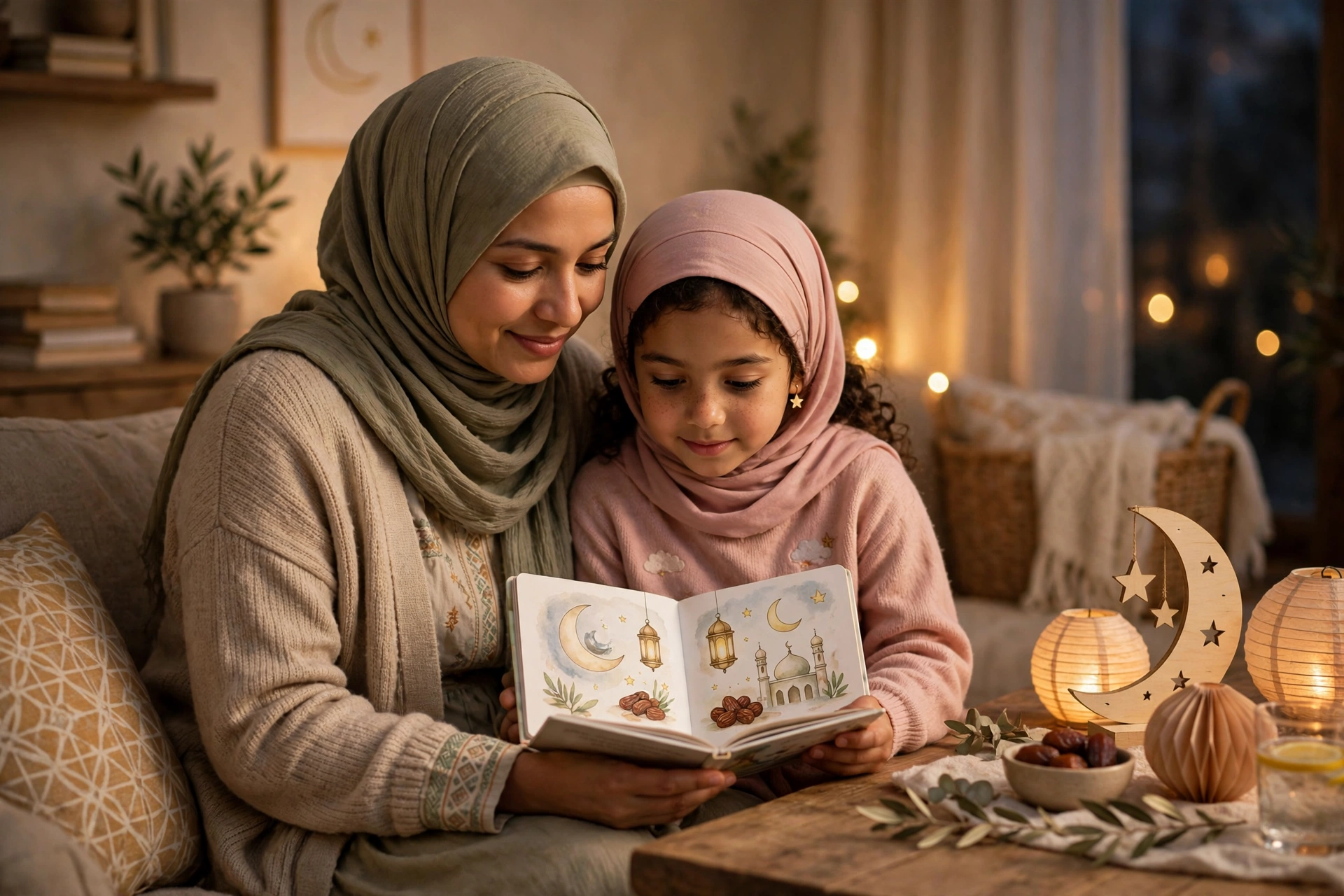
The evenings are the best time. After iftar, the house slows down. Read a story about Ramadan together, or a short passage in words a child can follow. Ten quiet minutes together each evening will be what the child remembers. A countdown helps too. A paper chain on the fridge, one link off each night, marks the special nights as they come. The last ten nights are the most important part of the month, and you can simply say they are extra special.
How Does a Simple Good-Deeds Chart Work?
A good-deeds chart is a sheet of paper on the wall with a row for each day of Ramadan and a space for one good deed a day. The child picks the deed, does it, and sticks a star on the chart. It answers what is Ramadan for kids in a way a child can see: one good deed a day, one star on the wall.
Keep the deeds small and real. Help a brother with his shoes. Share a toy without being asked. Say something kind to a grandparent. Put a coin in the charity box. Clear the table after iftar.
Let the child choose. A chart the parent fills in feels like homework. A chart the child fills in feels like a game. If she misses a day, nothing happens. The star waits for tomorrow.
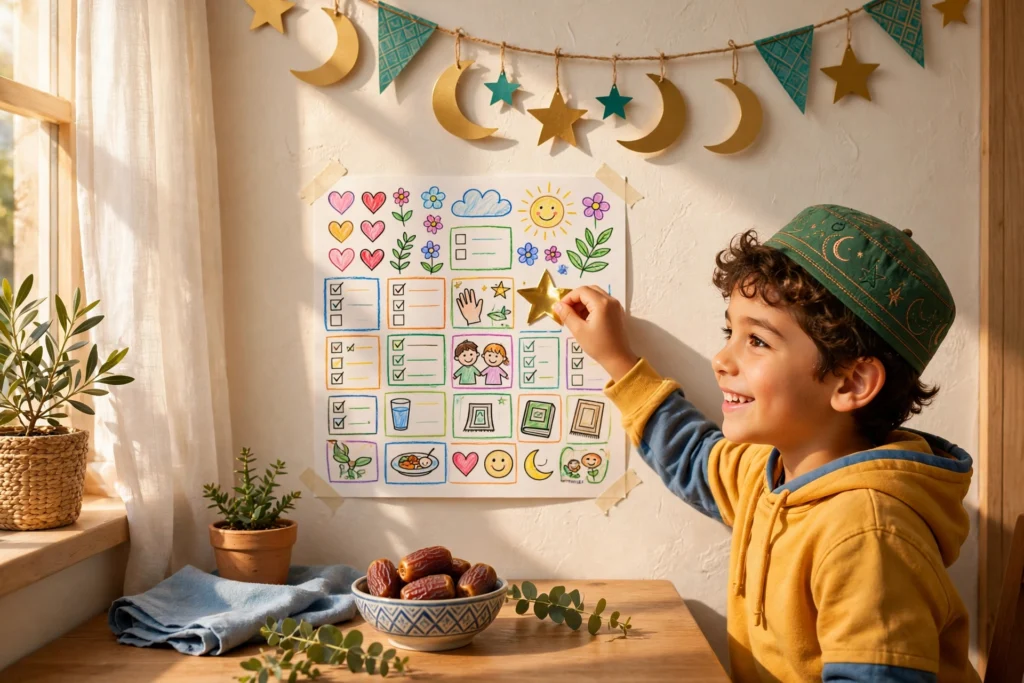
You can tie the chart to giving as well. Many families keep a small charity box on the table during Ramadan, and the child drops a coin in each evening. By Eid, the box holds a small sum, and the child can help choose where it goes.
What Should Teachers Know If a Pupil Is Fasting?
Most teachers want to help, and most of what they need is simple information. If your child is fasting, even for half the day, tell the teacher before the month starts. A short note or a quick word at the school gate is enough.
Teachers should know three things. The child may be quieter than usual in the afternoon. She may need a place to sit during lunch, rather than the dining hall. And she may need to break the fast if she feels unwell, without fuss. A teacher who knows in advance can handle all of that easily. That is the teacher’s side of what is Ramadan for kids: a little information, given early.
It helps to explain the dates too. Ramadan moves each year, so a teacher who had a fasting pupil last spring may not expect one this February. Ramadan 2027 is expected to begin on Monday, 8 February, so the month will fall during term time. The fasts are short in February, around eleven hours in much of the US.
Eid matters as well. Eid al-Fitr is expected on Tuesday, 9 March 2027, and many families keep children home that day. Tell the school in advance, and ask what work the child will miss.
Children learn giving by doing it. Our Eid Packs let a child choose a gift for another child, so the joy of Eid reaches a family that needs it.
Give an Eid Pack →Frequently Asked Questions
What is Ramadan for kids?
What is Ramadan for kids? It is a special month when Muslims fast from dawn to sunset, pray more, and give to people who need help. Children do not have to fast. They join in by helping at home and counting down to Eid.
At what age can a child start fasting?
Fasting becomes obligatory at puberty, not at a set age. Before that, children may try a half fast when they ask to, often around seven or eight, and only if they are keen. A child who feels unwell should stop at once.
How do I explain Ramadan to a five-year-old?
Keep it to three sentences. Ramadan is a special month. Grown-ups skip food and water during the day to remember God and people who are hungry. When the sun goes down, the family eats together, and at the end of the month there is a party called Eid.
Should a child fast at school?
Only if the child wants to, and only a half fast to start with. Tell the teacher in advance, pack water and a snack, and make sure the child knows she can break the fast whenever she needs to.
What is a half fast?
A half fast is fasting for part of the day, usually from dawn until midday, or from midday until sunset. It is a way for a child to practise, not a duty, and the child can stop at any time.
When does Ramadan 2027 start?
Ramadan 2027 is expected to begin on Monday, 8 February 2027. Eid al-Fitr is expected on Tuesday, 9 March 2027. Both dates depend on the sighting of the new crescent moon, so they may move by a day.
Many families teach giving alongside fasting – our Eid Packs let a child choose a gift for another child.