So Eid is around the corner again. If you’re reading this, you’re probably one of two people. Either you’re trying to figure out how to do your Qurbani this year without all the mess of finding a butcher, or you want to make sure your sacrifice actually reaches someone who needs it. Maybe both. Either way, I’ve been there, and this guide is going to walk you through everything you need to know about Qurbani donation in 2026.
Let’s just get into it.
When Is Qurbani 2026?
Eid al-Adha 2026 is expected to fall on Wednesday, May 27, 2026. That’s the 10th of Dhul Hijjah, 1447 AH. The exact day still depends on the moon sighting in your country, so keep an eye on your local mosque announcements. The first ten days of Dhul Hijjah are expected to begin on May 18, 2026, and the Day of Arafah falls on May 26.
You have three days to do your Qurbani. That’s the 10th, 11th, and 12th of Dhul Hijjah. Some scholars include the 13th, but most stick to three days. Once Maghrib hits on the final day, the window closes. No second chances.
This is why people are saying donate early. Last year I waited too long and ended up scrambling on the second day of Eid trying to find a charity that still had slots open. Don’t be me.
What Is Qurbani Actually About?
You probably already know the story but a quick refresher never hurts. Prophet Ibrahim (AS) had a dream where Allah told him to sacrifice his son Ismail (AS). He was ready to do it. His son was ready too. That kind of submission is hard to even imagine. Right before the sacrifice, Allah replaced Ismail with a ram. That moment is what we remember every year on Eid al-Adha.
Qurbani is our way of carrying forward that legacy. We sacrifice an animal, and the meat gets shared. Traditionally one third stays with the family, one third goes to relatives, and one third goes to the poor. But here’s the thing. If you’re living in the US, UK, Canada, or anywhere meat is easy to get, the “poor” part is what really matters. That’s why so many Muslims now donate their full Qurbani share to people who would otherwise never eat meat that month.
Is Qurbani Compulsory? Is Qurbani Farz?
This is where things get a little confusing because the answer depends on which school of thought you follow.
If you follow the Hanafi school, which is the majority in South Asia, Turkey, and most of Central Asia, Qurbani is wajib. That means it’s obligatory. Not optional. If you have wealth above the nisab threshold, you’re expected to give. Skipping it without a valid reason is considered sinful in this view. There’s a hadith where the Prophet (SAW) said, “Whoever can afford to offer a sacrifice but does not do so, let him not come near our prayer place.” That’s pretty direct.
If you follow the Shafi, Maliki, or Hanbali schools, Qurbani is Sunnah Muakkadah. That means a strongly recommended Sunnah but not strictly obligatory. You won’t be sinful for missing it, but you’ll be missing out on huge rewards.
Now to be clear, Qurbani is not technically farz in the same way Salah or Fasting are farz. Even the Hanafi position calls it wajib, which is a category just below farz. But for practical purposes, if you’re Hanafi and you meet nisab, treat it like it’s required.
The nisab threshold is the same as Zakat. Roughly the value of 87.48 grams of gold or 612.36 grams of silver. Most scholars now use the silver threshold since it’s lower and more inclusive.
Qurbani Rules for Family: Per Person or Per Household?
This is the question I get asked the most.
Here’s the simple version.
Hanafi view: Every adult in the household who meets nisab gives their own Qurbani. So if you, your spouse, and your adult son all meet nisab, that’s three separate Qurbanis. A husband doesn’t automatically cover his wife if she has her own savings or gold that meet nisab. She gives her own.
Shafi, Maliki, Hanbali view: One Qurbani from the head of household covers the entire family. Even if you have ten people living under one roof, one sacrifice is enough.
Both views come from valid hadith. Abu Ayyub al-Ansari (RA) said that during the time of the Prophet (SAW), a man would sacrifice one sheep on behalf of himself and his whole household, and they would eat some and share the rest. The Shafi, Maliki, and Hanbali scholars lean on this. The Hanafis read other hadith and rulings differently and conclude individual obligation.
What does this mean for you? Follow what your family follows. If you grew up Hanafi and you’re not sure, just go with that. If you’re stuck, ask your local imam. Don’t overthink it.
One more thing. You can absolutely give Qurbani on behalf of someone who has passed away. A lot of people do one for a deceased parent every year. It’s considered ongoing charity. Charities usually have this option right at checkout.
Which Animals Count?
Not every animal qualifies. The eligible ones are sheep, goats, cows, buffalo, and camels.
A sheep or goat counts as one share. So that’s one full Qurbani for one person.
A cow, buffalo, or camel counts as seven shares. So seven people can split one large animal. This is what a lot of families do. Buy one cow together and each adult takes a share.
The animal also has to be a certain age and free from major defects. No blind animals, no animals missing significant body parts, nothing severely sick. The charities handle all this verification, which is honestly one of the biggest reasons people donate online instead of doing it locally.
Why Donate Your Qurbani Online?
Look, I’m not going to pretend doing Qurbani in person isn’t meaningful. If you have access to a halal farm and you want to be there, that experience is something else. But for most of us, that’s just not realistic anymore. Especially if you live in a city, work full time, and don’t have the connections.
Here’s why online Qurbani donation has become the go to option for so many Muslims.
It reaches the actual needy. Most charities perform Qurbani in places like Yemen, Somalia, Syria, Gaza, Bangladesh, Pakistan, and Afghanistan. For families in these countries, this might be the only meat they eat all year. Think about that. One Qurbani share. One whole year.
It’s done properly. Trusted charities make sure the slaughter happens after Eid prayer, within the correct days, by qualified people, and on healthy eligible animals. They handle the meat distribution and you get a confirmation when it’s done.
It’s affordable. Qurbani starts around $45 for a sheep or goat share in countries with lower costs. A cow share can be anywhere from $80 to $200 depending on the country and the organization. You can usually pick which country you want it done in.
It saves you time. You finish your Qurbani in two minutes from your phone. Done. You can focus on the spiritual side of Eid without worrying about logistics.
How to Donate Qurbani Online Step by Step
Pretty straightforward. Here’s roughly what the process looks like.
First, pick a charity you trust. Look for ones that have been doing this for years, have transparent reporting, and tell you exactly where your sacrifice will take place. Some popular ones include Islamic Relief, Muslim Hands, Human Appeal, Penny Appeal, Muslim Aid, and Zakat Foundation, but there are plenty of solid options locally too.
Then choose your animal and the country. Some charities let you pick. Others assign based on need. Both are fine.
Add the number of shares you need. If you’re Hanafi and have three adults at home above nisab, that’s three shares. Add one or two extra for deceased family members if you want.
Pay online. Card, bank transfer, sometimes even PayPal or Apple Pay.
You’ll get confirmation. After Eid, most charities send a notification that your Qurbani has been performed and the meat has been distributed.
That’s the whole thing.
Things to Avoid the Days Before
If you’re planning to do Qurbani, there’s a Sunnah that says once the moon of Dhul Hijjah is sighted, you shouldn’t cut your hair or nails until your sacrifice is done. The Prophet (SAW) said, “When the ten days come and one of you intends to sacrifice, let him not cut his hair or his nails.”
Most scholars consider this a strong recommendation, not an obligation. Hanafis are a bit more relaxed about it. But if you can hold off, do it. It connects you spiritually to the act of sacrifice.
Also, don’t fast on the day of Eid itself. Fasting on the two Eids is actually forbidden. But fasting on the Day of Arafah (the day before Eid for non pilgrims) is a powerful Sunnah. The Prophet (SAW) said it expiates the sins of the previous and following year.
Final Thoughts
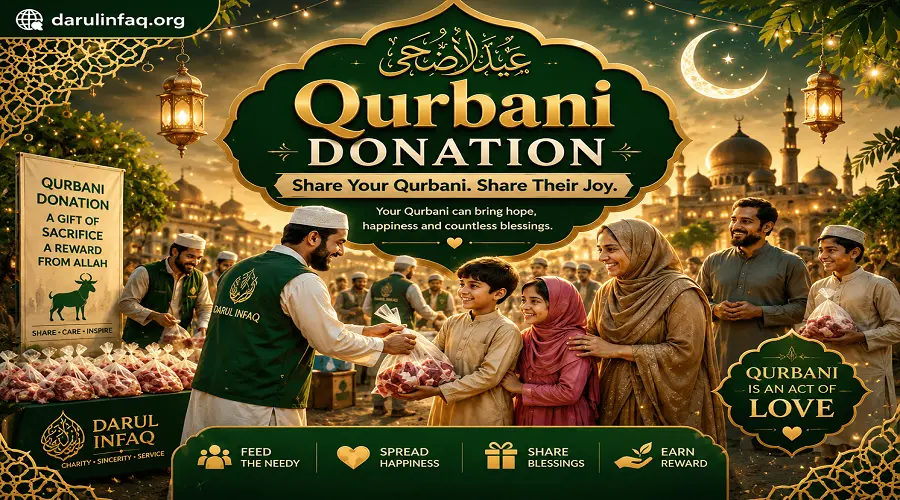
Qurbani isn’t just about slaughtering an animal. It’s about remembering what Ibrahim (AS) was willing to give up and asking yourself what you’re willing to sacrifice for the sake of Allah. Every year, many people delay their Qurbani plans until the last moment. This year, make it easier on yourself by arranging it early through trusted organizations like Darul Infaq while slots are still available and prices remain reasonable.
Your sacrifice doesn’t end when the animal does. The meat reaches a family that hasn’t had a real meal in weeks. A child eats something warm. A widow has something to put on the table. That’s where the reward lives.
May Allah accept your Qurbani and ours. Eid Mubarak in advance.