
1. What is Fidya?
Fidya is the obligation to feed a poor person for each fast missed when someone is permanently unable to fast due to reasons such as:
- Old age and frailty
- Chronic illness with no expectation of recovery
Permanent medical conditions where fasting would cause harm
This is based on the Qur’an:
“…_*And upon those who are able (to fast, but with hardship) – a ransom (Fidya) of feeding a poor person (for each day)._*”
(Surah Al-Baqarah 2:184)
2. *Who must pay Fidya?*
Fidya applies only when:
- The person cannot fast, AND
- They cannot make up the fast later
If someone is temporarily sick or traveling, they must make up the fast later (Qadha), not pay Fidya.
3. *What is the Fidya amount?*
The requirement is to provide food equivalent to feeding one poor person for one day per missed fast.
There are two acceptable ways:
Option 1: Feed one poor person two meals
- This is the most literal and preferred method.
- Two average meals (or equivalent groceries) per missed fast.
Option 2: Give the monetary equivalent
Based on the cost of two average meals.
Fidya through Darul Infaq – Making it easy and impactful
Fidya is fulfilled by feeding one needy person for each missed fast—equivalent to two meals for a day.
Through Darul Infaq, we are able to provide essential groceries in regions where food costs are lower, allowing us to fulfill Fidya by feeding one person for a day at $3 per fast.
This amount has been intentionally kept affordable to help seniors and others on limited incomes fulfill their obligation, while ensuring that deserving families receive proper meals with dignity.
Every $3 Fidya provides real nourishment to someone in need and fulfills this important responsibility.
4. *Total Fidya for full Ramadan*
If someone misses all 30 fasts:
- Feed 30 poor people two meals each, OR
- Feed one poor person for 30 days, OR
- Pay equivalent amount (example: $3 x 30 = $90 in USA)
5. *Significance of Fidya*
Fidya reflects Islam’s balance between mercy and responsibility:
- Allah does not burden beyond one’s capacity
- Yet ensures the spirit of Ramadan—caring for the needy—is preserved
- It transforms inability into an act of charity and compassion
Even when someone cannot fast physically, they still participate spiritually.
6. *Important distinction: Fidya vs Kaffarah*
- *Fidya* → For inability to fast (valid excuse, permanent)
- *Kaffarah* → Penalty for intentionally breaking a fast without valid reason (much stricter)
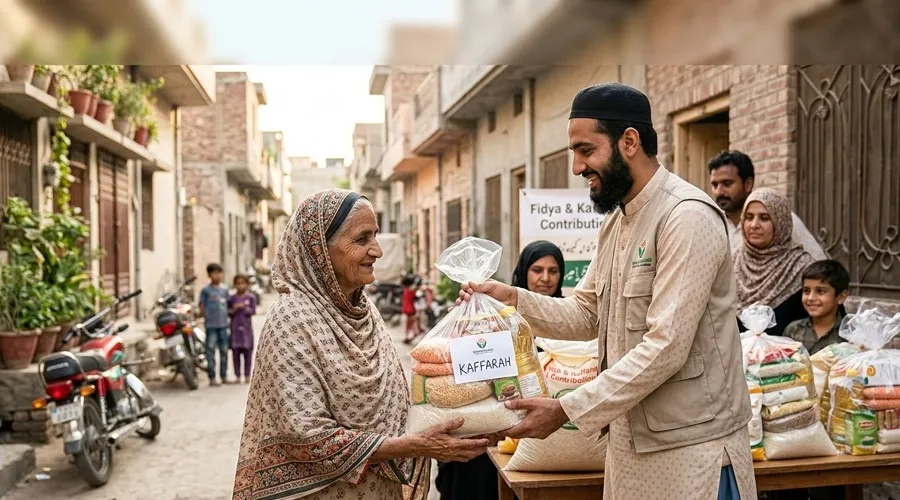
7. Practical example (your Fidya packs initiative)
Providing grocery packs equivalent to two meals per fast per recipient is fully valid and excellent, especially since it:
- Provides real nourishment
- Preserves dignity
- Has lasting impact
This aligns beautifully with the purpose of Fidya.
May Allah accept your Fidya and multiply its reward. Ameen.